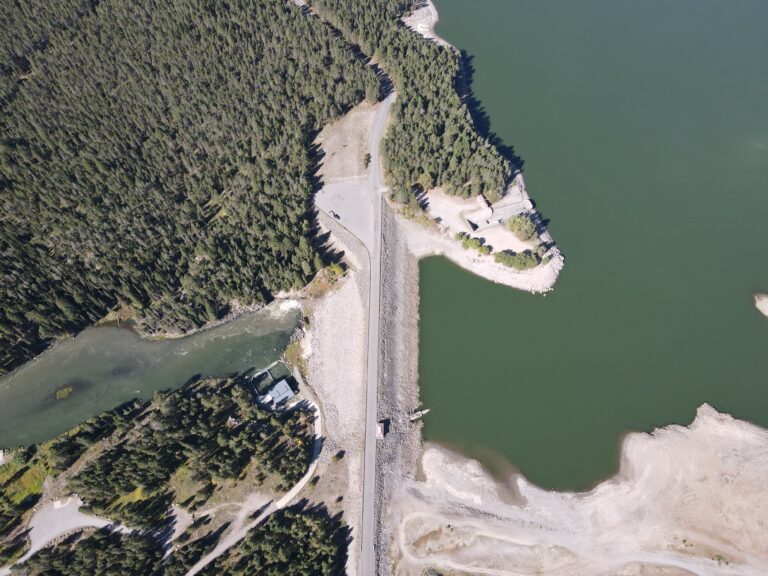
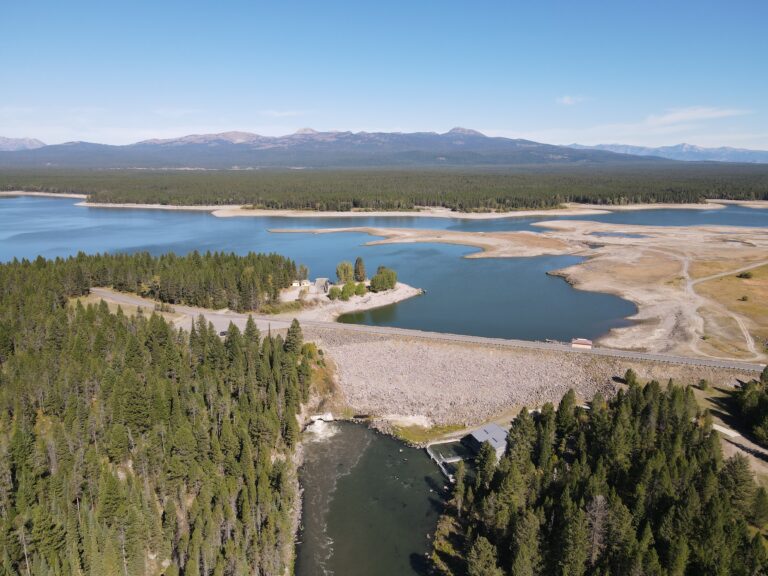
The Henry’s Fork is unique in that summer water temperatures between Island Park Dam and Pinehaven are affected more by air temperatures and solar radiation (sunlight), than streamflow. Although water temperatures above 68 degrees F start to be less optimal and more stressful for trout, the Henry’s Fork has abundant food and high levels of dissolved oxygen, which offsets the stress that trout might experience at these higher temperatures.
What affects Water Temperatures?
On the Henry’s Fork, between Island Park Dam and Pinehaven, summer water temperatures are not affected by streamflow unless flows are so low that the water becomes stagnant and unchanging due to lack of movement. This is because the stream bottom is wide, shallow, and dark, with large amounts of volcanic rock.
Instead, water temperatures are affected by:
1. Air temperatures
2. Solar radiation (sunlight)
The need for farmers to irrigate (water) crops ensures that outflow from Island Park Dam does not get too low during the heat of the summer, as average flows are generally ~1,000 cfs.
What affects Water Temperatures in Island Park Reservoir?
Research has shown that Island Park Reservoir outflow temperatures increase as summer outflow increases. For instance, when water is drawn from the reservoir quickly, this can cause warm and cool layers to mix faster, which reduces the amount of cool water available at the bottom of the reservoir. The faster the reservoir drops, the warmer the water will be, both in the reservoir and in the reservoir’s outflow in Box Canyon.
What is the Optimal Water Temperature for Rainbow Trout?
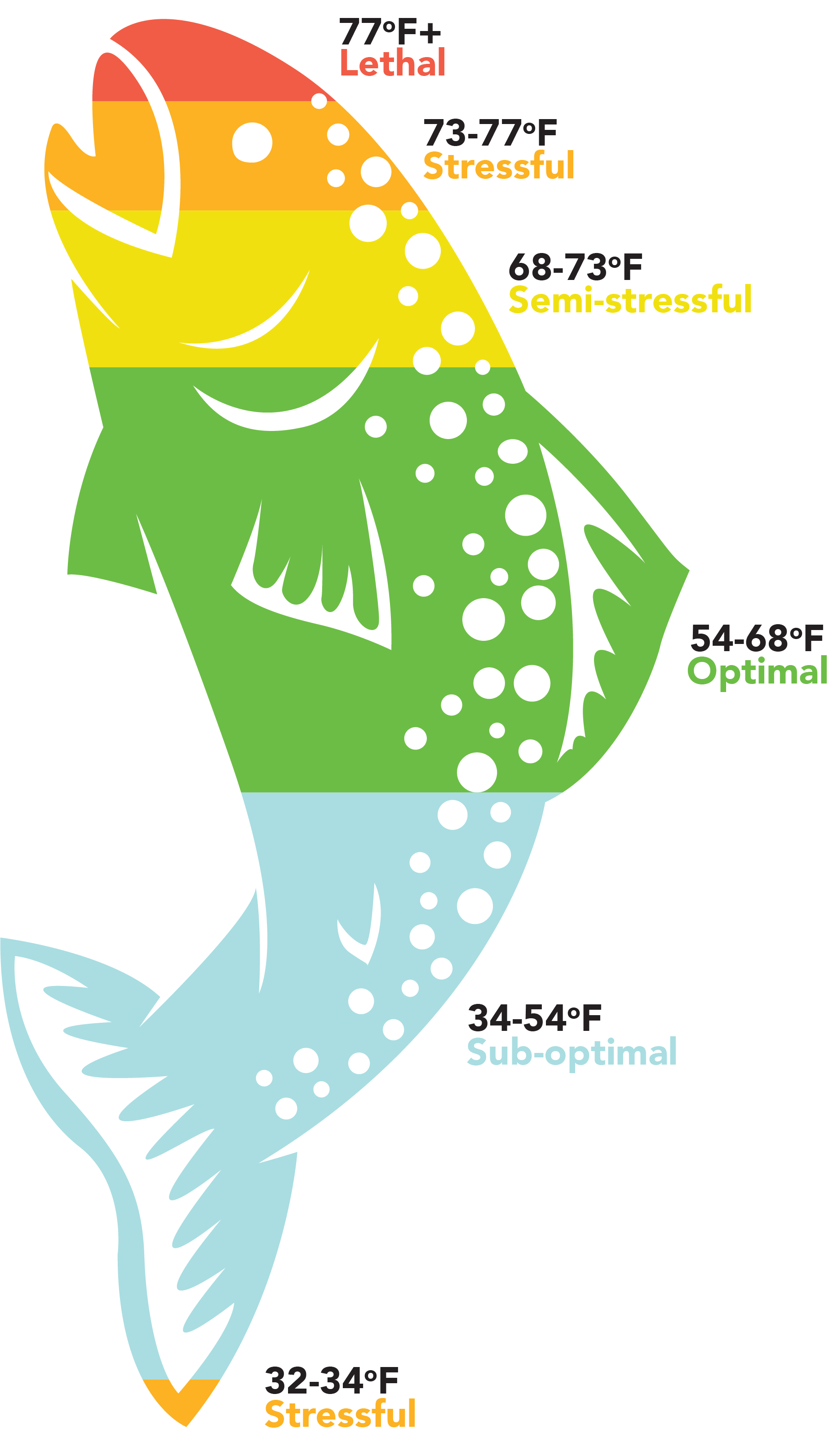
Water Temperature Thresholds for Rainbow Trout
The optimal range for rainbow trout growth and activity tops out at 68 F. The Henry’s Fork, however, is a unique environment. Because trout have high dissolved oxygen levels and the availability of large amounts of food, the closer that water temperatures are to 68 F, the faster that trout on the Henry’s Fork grow. Trout become “semi-stressed” with water temperatures between 68-73 F, and conditions become “stressful” when temperatures are above 73 F.
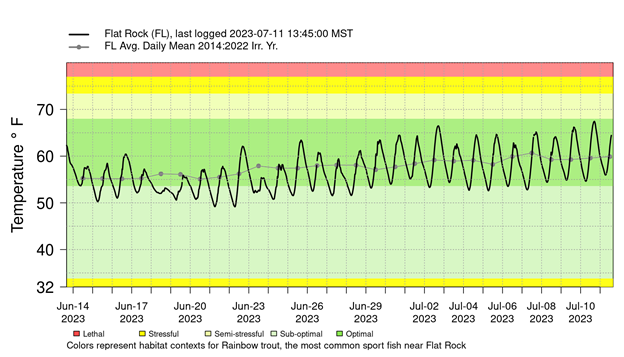
Flat Rock Temperature Data from HFF’s Water Quality Website
Dissolved Oxygen on the Henry’s Fork
Dissolved oxygen is the amount of oxygen available in the water and available to aquatic life, and it plays a critical role for fish. The Henry’s Fork is unique because it is able to maintain high dissolved oxygen levels throughout all sections of the river. In some areas, such as the upper Henry’s Fork, Harriman State Park, and Ashton to St. Anthony, photosynthesis by aquatic plants help to create substantial amounts of oxygen, regardless of the water temperature. Photosynthesis is where plants change the energy in sunlight to the types of energy that can be stored and used later. This means that the plant takes in energy from the sun and uses it to convert water and carbon dioxide into things such as oxygen and sugars.
In canyon reaches, high velocities (speeds) and waterfalls allow oxygen from the atmosphere (air) to mix into the water. Even in reaches downstream of St. Anthony, the oxygen created from the photosynthesis of plants and the mixing of oxygen from the atmosphere into the water helps to maintain high dissolved oxygen levels.
In nearly 9 years of continuous monitoring of dissolved oxygen throughout the watershed, HFF’s sonde network has never detected any dissolved oxygen issues, the only exception being temporary decreases at Island Park Dam due to equipment issues. However, the hydropower company works diligently to get issues resolved quickly.
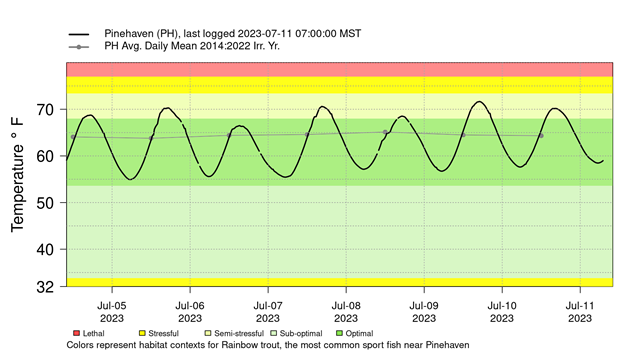
Pinehaven Temperature Data from HFF’s Water Quality Website
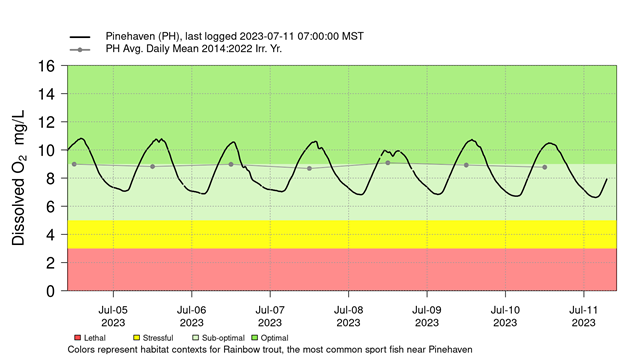
Pinehaven Dissolved Oxygen Data from HFF’s Water Quality Website
How HFF Monitors Water Quality and Temperatures throughout the Watershed:
Did you know that HFF monitors water temperatures in two different ways?
1. HFF Water Quality Monitoring Program
- 11 Water Monitoring Stations
- These stations use sondes to measure the quality of the water. The sondes stay submerged in the water 24/7 and send information to HFF’s water quality website every 15 minutes, and the website updates in real- time.
- Water temp data: henrysfork.org/river-conditions
2. HFF’s Harriman Ranch Water Temperature Monitoring Project
- 18 Data Loggers
- Anglers voiced concern that the Ranch is warmer than other reaches, so HFF is collecting more data throughout this summer (2023) to ground-truth our current understanding.
- The data loggers are placed throughout Harriman State Park.
- The aim of this project is to better understand the temperature differences in the river.
- Harriman Temperature Project Info: https://henrysfork.org/post/temperature-monitoring-in-hsp-let-s-get-the-summer-rolling
What can we do to Decrease Water Temperatures in the Henry’s Fork?
Because the Henry’s Fork is a naturally wide, flat, shallow river, the options for mitigating water temperatures are going to differ from the measures used within a narrow stream habitat. Some options include:
1. Restore tributaries that flow into the river between Last Chance and Pinehaven
2. Managed aquifer recharge in locations that will increase inflow of cool groundwater to the river
3. Keep more water in Island Park Reservoir