Christina Morrisett

Fish Icon
Christina Morrisett
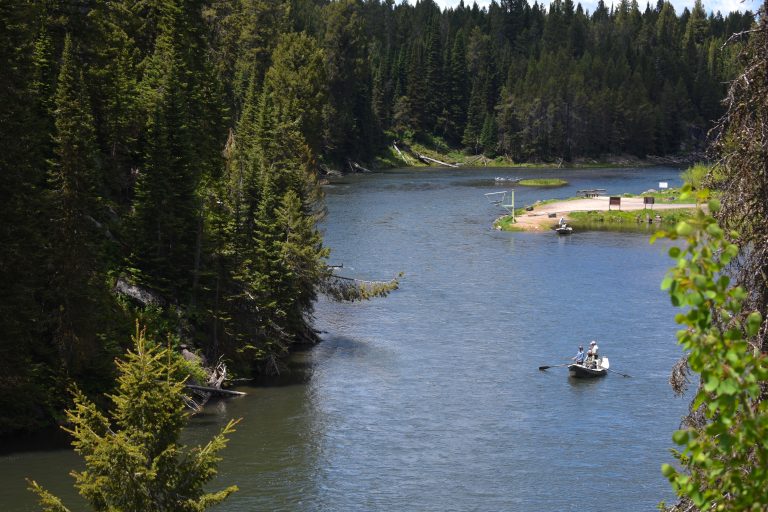
Drift boat with anglers rowing downriver surrounded by tall trees
Christina Morrisett

The River Rundown: Your FAQs from June 2025

“It feels like July!” was a common sentiment shared around the watershed last month. Anglers enjoyed Brown Drakes on the Ranch three weeks earlier than usual, basked in 70°F more days than not, and endured high outflows from Island Park Dam that are more typical for mid-July. Some of these changes were welcome… others, not so much. Below, we answer your most Frequently Asked Questions from June. FAQ: Outflow from Island Park Dam peaked around 1,600 cfs. Why so high, so early? Warm and dry conditions increased irrigation demand in the lower watershed 10% higher than average. To meet irrigation demand and maintain fish habitat around St. Anthony, water managers rely on water delivered from Island Park Reservoir and on natural streamflow Natural streamflow comes from mountain snow and groundwater springs—but is 38% below average. Therefore, Island Park Reservoir has to work that much harder to make up the difference. With so little water in the system, high outflow in Island Park is needed just to keep the river wet 60 miles downstream. FAQ: What’s up with the constant flow changes at the dam? In wetter years prior to the year 2000, there was enough water to go around—so managers
Read More »
Meeting notes for the 2025 HFF membership meeting collected in doodle form
Christina Morrisett

2025 Membership Meeting Recap

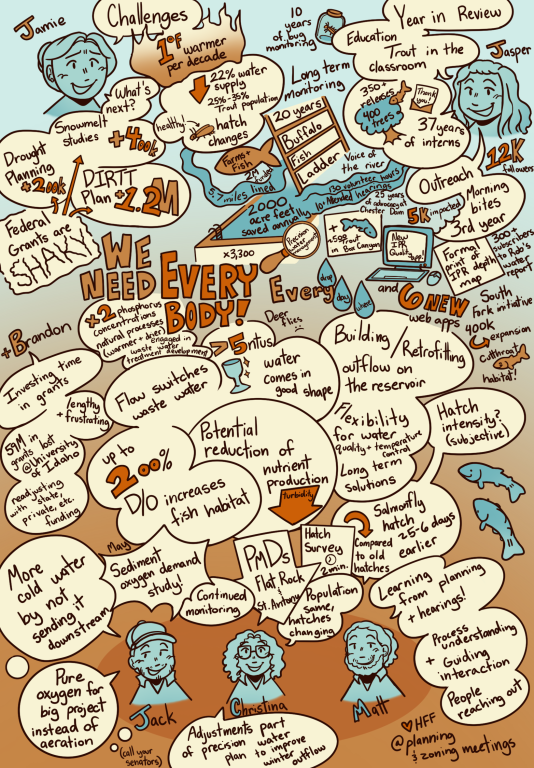
Visual abstract for the 2025 HFF Membership Meeting created by Teddy Montalvo, 2025 Baucus Climate Scholar On June 19, we gathered at the Boys House in Harriman State Park for the 2025 HFF Membership Meeting. In addition to meeting in a new place, we also tried a new structure: a 30-minute presentation by our Communications Team followed by a 30-minute Panel Q&A with members of HFF’s Science & Technology Team. Thank you to all who joined us! Missed the meeting? You can watch the meeting recording here. Want the highlights? Read below or check out the visual abstract above! Programmatic Highlights Community Connections Education: HFF expanded our Trout in the Classroom program to five classrooms, now reaching 130 students. High school volunteer opportunities for the South Fork Initiative helped restore Rainey Creek and improved local intern recruitment. Our college internship program continues, now in its 37th year. Outreach: HFF’s executed 44 Morning Bites events at local river access sites, gave 40+ scientific presentations, and hosted booths at 12 community events. In total, HFF reached an estimated 5,000 community members. Voice of the River: HFF was an active participant at 10 Planning & Zoning meetings. We hosted three river clean ups and want to

Read More »
A salmonfly nymph and newly-hatched adult sit on a blade of grass alongside the river. Text reads "What's Hatching? (Or Not)"
Christina Morrisett

What’s Hatching on the Henry’s Fork?

In this blogpost, learn about what we know, what we don’t know, and how you can help by reporting the hatches you see (or don’t see) every time you visit the river. Check out the Henry’s Fork Hatch Survey today at tinyurl.com/hfhatchreport. What We Know The Henry’s Fork Foundation has been monitoring aquatic macroinvertebrates (insects) at multiple locations since 2015. Each March (normally on St. Patrick’s Day), HFF and a team of entomologists from River Continuum Concepts head out to the Henry’s Fork to scrub rocks and collect bugs from the river-bottom for expert identification and robust analysis to answer questions like: How many bugs are there? (Abundance) What kind of bugs are there? (Species Diversity, Richness, Composition) How have the bugs changed through time? As scientific river detectives, we pair aquatic insect numbers with water quality and streamflow data and run it through rigorous statistical analysis to better understand changes to the macroinvertebrate community. What have we learned so far? A decade of data show that aquatic invertebrates on the Henry’s Fork are largely happy and healthy. When it comes to Pale Morning Duns, we are seeing declines in abundance at Flat Rock and St. Anthony, but no trends one way

Read More »
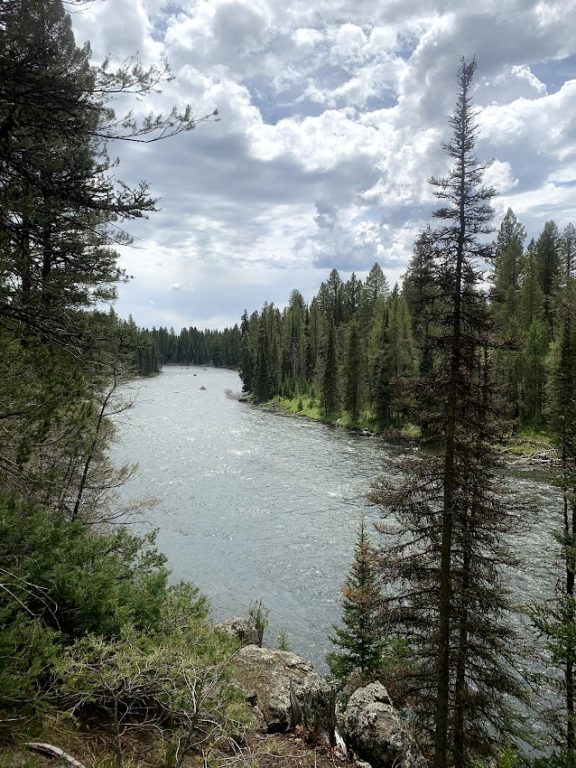
Snake river surrounded by trees
Christina Morrisett

Snow to Streamflow: A Story of Decline [Part 2]

Snow to Streamflow: A Story of Decline [Part 2] In snowy regions like the Henry’s Fork, the amount of water held in the snowpack on April 1st can help predict summer streamflow. But over the past two decades, the relationship between the water stored in spring snowpack and summer streamflow has changed, making summer streamflow less predictable. New research by HFF and Idaho State University scientists show how we can improve our summer streamflow predictions by better understanding when snowmelt and rain enter the ground relative to the forest growing season. Key Takeaways: The amount of snow that becomes streamflow depends on both past and current conditions. Predicting streamflow requires accounting for changing forest dynamics. Less snowmelt becomes streamflow after years when more water enters the soil during the forest growing season. Why is it important to be able to accurately predict water supply? Part 1 discussed how warmer temperatures and changing forest dynamics are contributing to water supply decline in the Henry’s Fork. At the Henry’s Fork Foundation, if we want to reduce drawdown of Island Park Reservoir and increase winter flows to grow more trout, we need to be able to accurately predict water supply. Understanding watershed processes are

Read More »
View of the mountains
Christina Morrisett

Snow to Streamflow: A Story of Decline [Part 1]

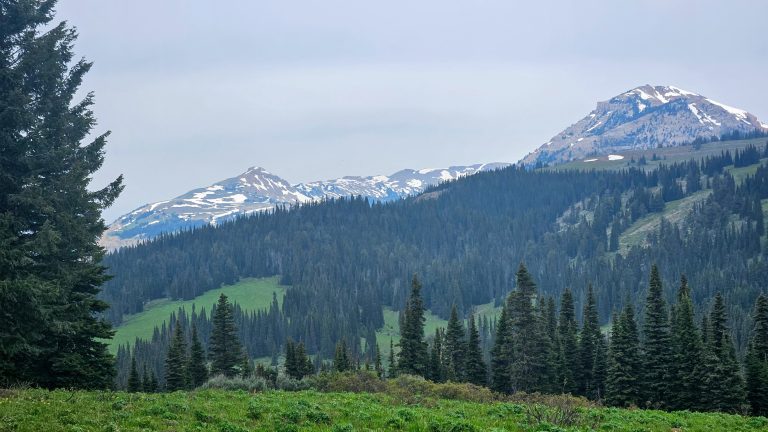
Henry’s Lake mountains, photo credit Sarah Newcomb Due to warmer growing seasons and denser forests, Henry’s Fork natural streamflow is declining and becoming less predictable. Over the past 20 years, the Henry’s Fork has seen a decline in natural flow, or the amount of water that would flow down the river in the absence of any reservoirs or irrigation diversions (aka the water Mother Nature gives us). At the same time, we are starting to see rainier, less snowy years , meaning the total amount of water entering the watershed each year hasn’t changed, but less is falling as snow. So, how do we have the same amount of water coming in… but less becoming streamflow? Where is the water going? With funding from the National Science Foundation in 2023, Dr. Sarah Newcomb set out to answer this question as part of her dissertation research at Idaho State University. Sarah worked alongside the HFF Science and Technology Team to investigate how snowmelt and rain becomes streamflow in the Henry’s Fork. As a mountain hydrologist, Sarah studies how water moves through mountain systems. Water in the Henry’s Fork primarily starts as snow that falls high in three major tributaries: the upper

Read More »