2025 Membership Meeting Recap

Home » Blog » 2025 Membership Meeting Recap
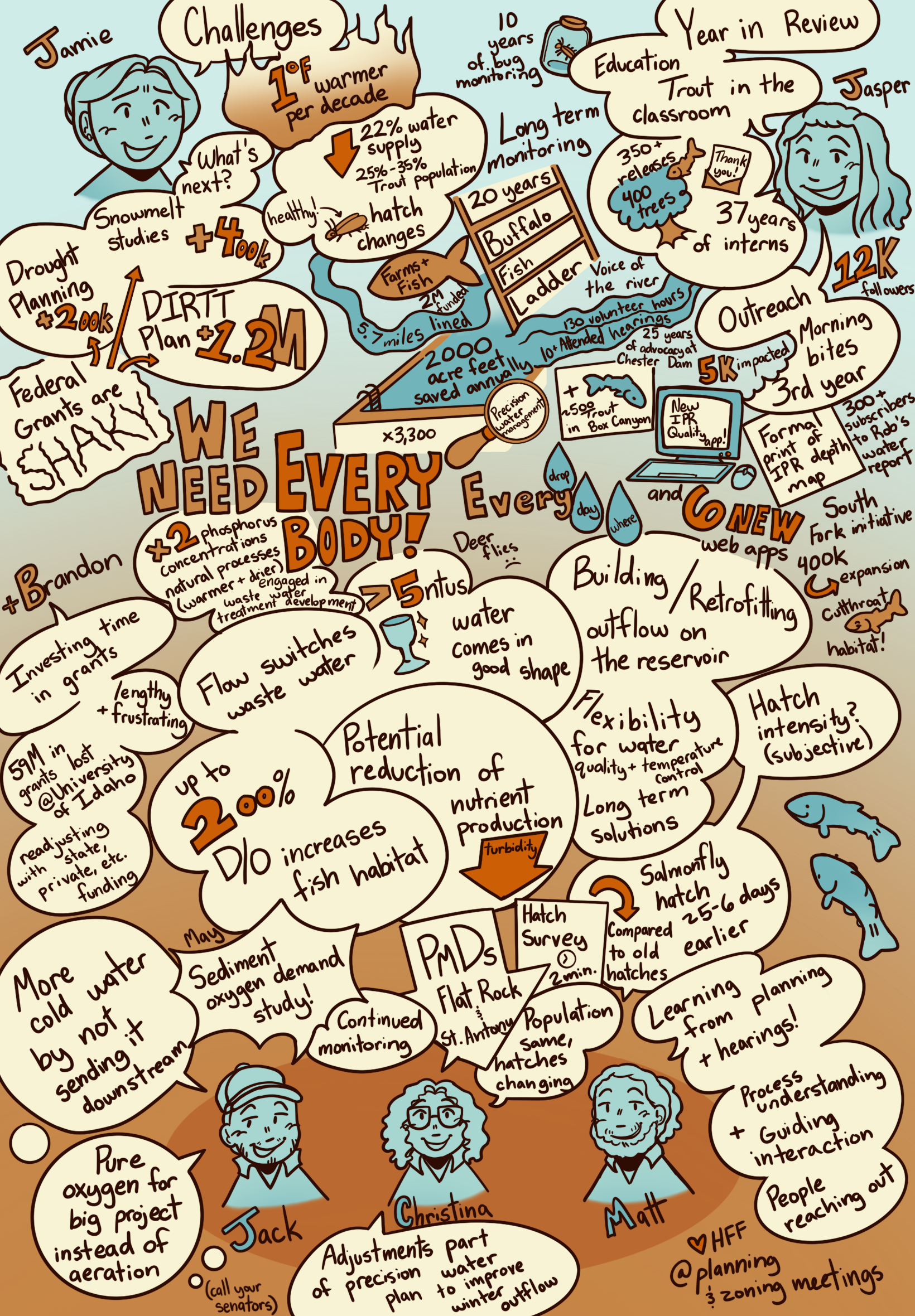
Meeting notes for the 2025 HFF membership meeting collected in doodle form

Visual abstract for the 2025 HFF Membership Meeting created by Teddy Montalvo, 2025 Baucus Climate Scholar

On June 19, we gathered at the Boys House in Harriman State Park for the 2025 HFF Membership Meeting. In addition to meeting in a new place, we also tried a new structure: a 30-minute presentation by our Communications Team followed by a 30-minute Panel Q&A with members of HFF’s Science & Technology Team. Thank you to all who joined us! Missed the meeting? You can watch the meeting recording here. Want the highlights? Read below or check out the visual abstract above!

Programmatic Highlights

Community Connections

  • Education: HFF expanded our Trout in the Classroom program to five classrooms, now reaching 130 students. High school volunteer opportunities for the South Fork Initiative helped restore Rainey Creek and improved local intern recruitment. Our college internship program continues, now in its 37th year.
  • Outreach: HFF’s executed 44 Morning Bites events at local river access sites, gave 40+ scientific presentations, and hosted booths at 12 community events. In total, HFF reached an estimated 5,000 community members.
  • Voice of the River: HFF was an active participant at 10 Planning & Zoning meetings. We hosted three river clean ups and want to specifically thank the 10 volunteers who donated a total of 130 volunteer hours in 2024. Lastly, we are pleased to announce that IDFG has acquired funding to improve road access to Chester Dam.

Data Data Data

  • Long-Term Monitoring: HFF celebrated 10 years of aquatic insect and water quality monitoring in 2024, and just completed 20 years of monitoring the Buffalo River Fish Ladder. We will continue these efforts into the future.
  • New Data Tools: Check out our 1) free digital depth map of Island Park Reservoir and 2) a new water quality web app that shares weekly reservoir conditions! Visit henrysfork.org/river-conditions to access HFF’s full data website collection.

Status Update

  • Farms and Fish: Completed the $2.1 million Conant Creek Canal Lining Project. This project lined 5.7 miles of canal and is expected to save 3,300 Olympic swimming pools worth of water in Island Park Reservoir annually.
  • South Fork Initiative: Continued efforts to monitor water quality and restore tributaries. Devan Ence hired as SFI Coordinator.

The Challenges We Face

Like many Western rivers, it’s warmer and we have less water. In the Henry’s Fork specifically, summer air temperatures have increased by about 1°F per decade over the last 40 years. These warmer temperatures play a key role in the lower water supply we’re experiencing and create a cascade of other challenges: less winter flow, decreased trout numbers, changes to hatch timing, and deterioration of mid-summer water quality in both Island Park Reservoir and the Henry’s Fork downstream.

What’s Next?

Mother Nature is giving us lemons and HFF is doing our best to make lemonade. In the last year, HFF was awarded three WaterSMART grants to continue our water conservation work and pursue big, bold solutions for water quality.

  1. In our $400,000 Snowmelt Study, we are installing high mountain weather stations to better understand the relationship between snowpack, snowmelt, and streamflow and improve river forecasts accordingly.
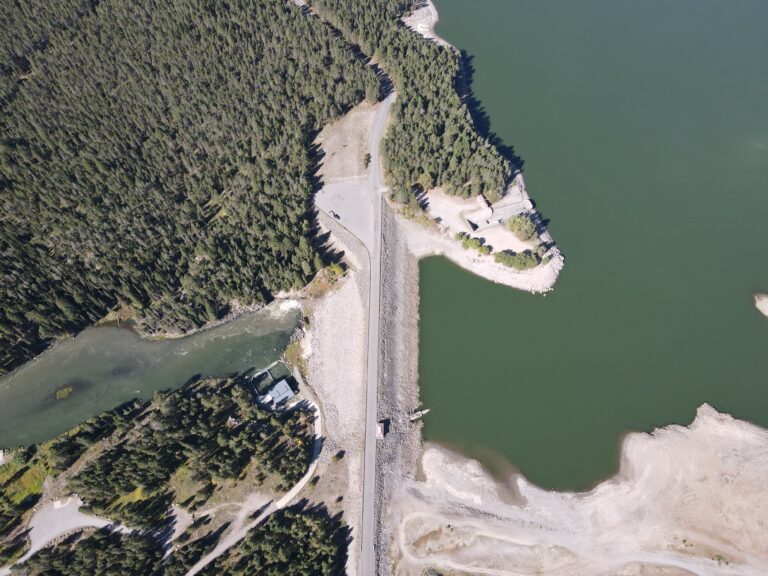
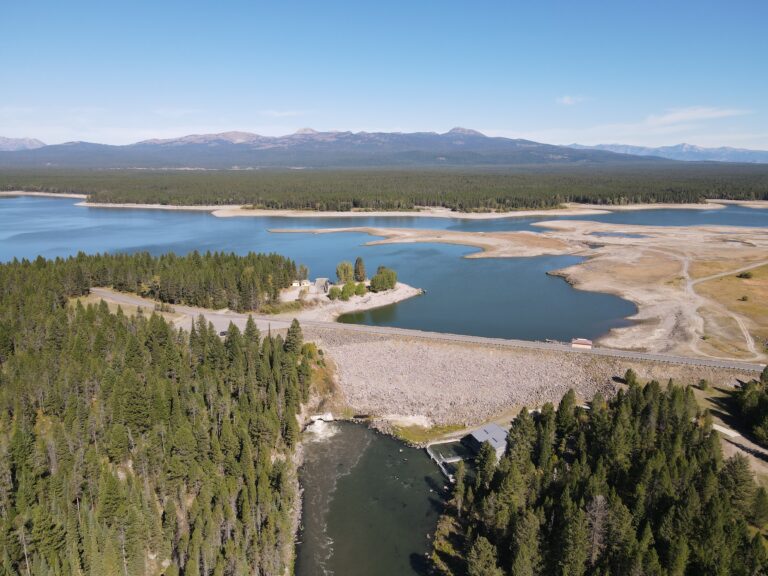
  2. In our $200,000 Drought Management Planning project, we are seeking ways to improve infrastructure at Island Park Dam to  increase winter flow and boost trout populations.
  3. In our $1.2 million DIRTT Plan, we are Developing Infrastructure to Reduce Temperature and Turbidity in Island Park Reservoir and the Henry’s Fork downstream. This project aims to improve water quality. Our solution portfolio is admittedly expensive and includes both engineered and nature-based solutions. Solutions include oxygenating the reservoir, building a variable elevation withdrawal system, and restoring tributaries.

Panel Q&A

Our panel discussion was led by audience questions and largely focused on DIRTT Plan details, the Henry’s Fork Hatch Data Survey, and HFF’s efforts regarding Planning & Zoning decisions in the watershed.

All of us here at the Henry’s Fork Foundation thank each and every one of you, our dedicated and kind membership, for your support this year and over the last 40 years. We could not do this work without you.

Facebook
LinkedIn
Pinterest

Recent Posts

South Fork
Patrick Nardi

SUMMER ON THE SOUTH FORK

It’s no secret that the Henry’s Fork is a river of grandeur. To those that fish it, it is like a church – a sanctuary that breathes fly-fishing legend. However, the South Fork quietly rumbles in the distance, with striking beauty, and equally legendary status. The South Fork’s deep, ripping currents, and plugging canyon walls hold many anglers fish of a lifetime. However, beyond trout fishing, it is the community deeply rooted in the waters

Read More »
Intern
Sam Pruitt

(Almost) Snow-less Snow Science

As an MSU undergrad studying snow science, a summer internship might sound unlikely. Fortunately, snow is an invaluable resource year-round out here in the west, providing the majority of our water supply. My original project with the Henry’s Fork Foundation was to install snow monitoring stations across the watershed to better capture the spatial variability of its winter snowpack, however funding and approval has been backlogged. Luckily, my mentor ,Dr. Otto Lang, had another project

Read More »
Intern
Audrey Hunter

My First Time Fly Fishing

Claude’s secret but likely identifiable fishing spot My first Sunday in Ashton, Claude, the Washington and Lee Intern, did me the great kindness of taking me fly fishing for the first time in my entire life. I am not in any way an experienced angler. I’ve caught one fish in my entire life. I can’t identify it, and I only caught it with the help of my vastly more experienced little brother. Upon arriving here,

Read More »
Intern
Kate Shiffler

Balancing Analysis and Adventure: A Week with the Field Work Intern

My name is Kathryn (Kate) Shiffler and I am the field work intern here at the foundation this summer! I am a rising sophomore at the University of Idaho, with a dual major in Conservation Biology and Wildlife Science. Although, from my work here so far, fisheries and aquatic science is starting to call my name. Crazy how one (or half of one) internship can change your mind so quickly! So, what does the Field

Read More »