Meandering

Home » Blog » Meandering
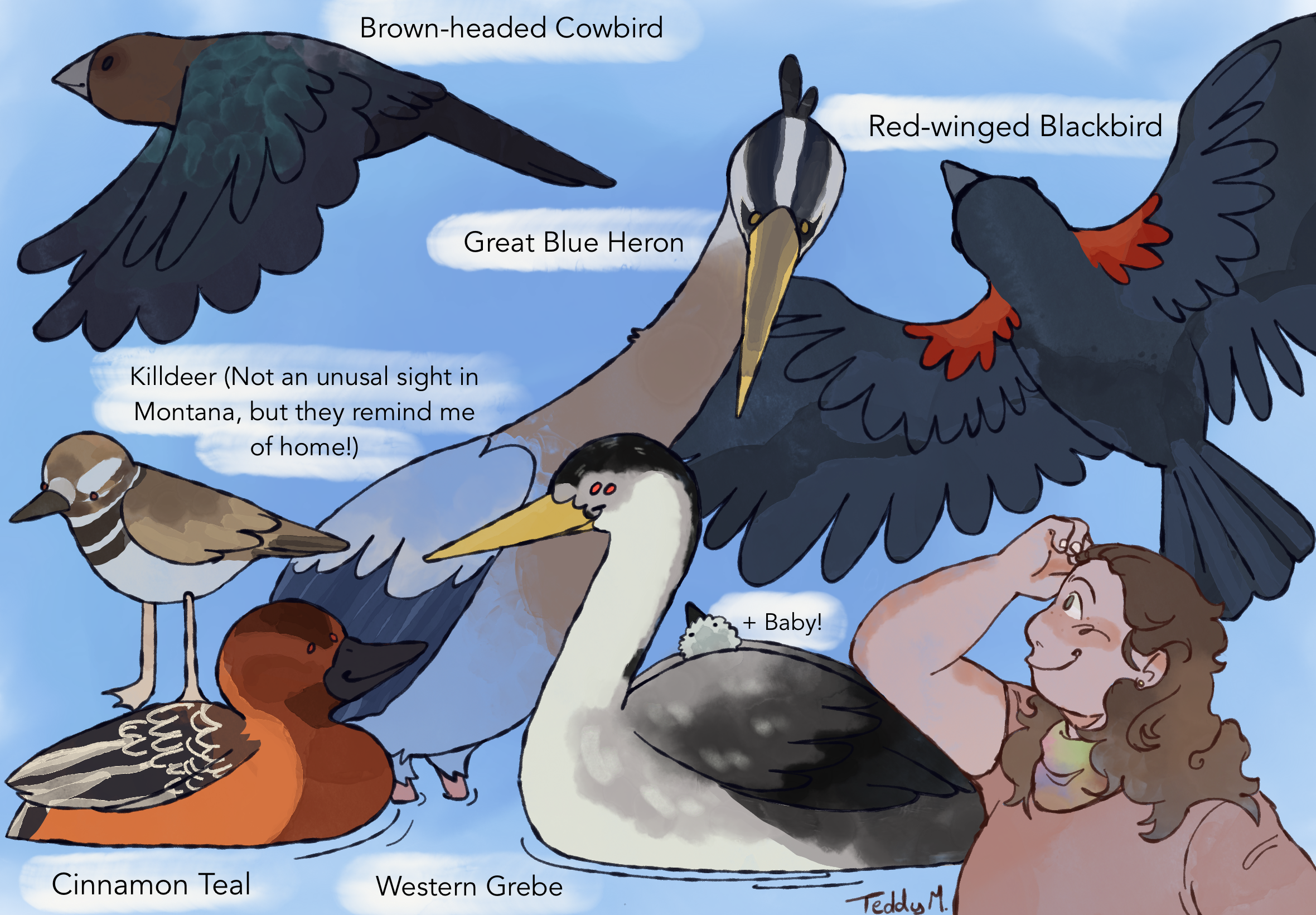
Digital illustration of assorted birds: Brown-Head Cowbird, Red-Winged Blackbird, Great Blue Heron, Killdeer, Cinnamon Teal, and a Western Grebe with her baby.

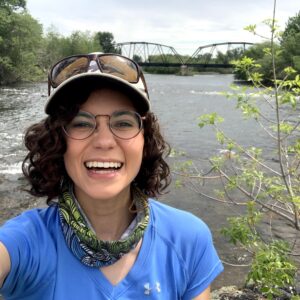
Happy July folks! My name is Teddy Montalvo and I am a rising junior from the University of Montana Western brought to Idaho by the Max S. Baucus Institute. My primary study is Environmental Sustainability with minors in Naturalism and Visual Arts. Hailing from my home town of Terry, Montana, I have adjusted to my new small town living without a hitch. In fact, everyone I have met so far has been more than pleasant and welcoming! It is easy to poke my head around town when there are so many friendly faces both in and beyond the Foundation walls.

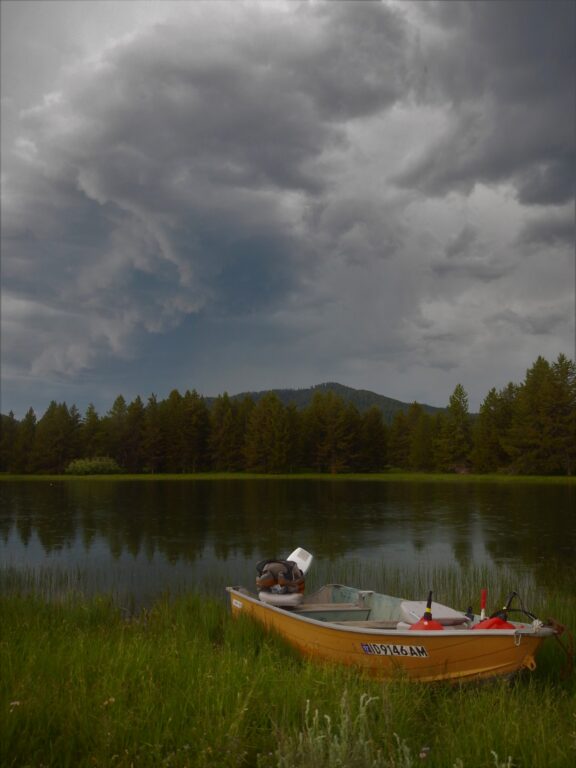
Already halfway through my 8 weeks with the Henry’s Fork Foundation (which I try not to think too hard about), I have been focused on illustrating water quality concerns the HFF DIRTT Plan aims to address. This, so far, has entailed detailed digital illustration of how factors like turbidity, temperature, and dissolved oxygen affect Island Park Reservoir and the Henry’s Fork downstream. I have invested a lot of time into each part of the process, from understanding the impacts of each factor to finding a way to infuse those ideas into a visual format! Although most of my work requires becoming close acquaintances with my desk, it is not impossible to spot me out and about—you may have seen me jumping chairs to flag bidders during the Henry’s Fork Days auction! I also tend to dabble in water quality fieldwork to tighten my grasp of the reservoir concepts I have read about and help frame my digital illustrations accordingly. Fieldwork has also been great for having someone more experienced than me can point out all the cool birds.

Digital illustration of assorted birds: Brown-Head Cowbird, Red-Winged Blackbird, Great Blue Heron, Killdeer, Cinnamon Teal, and a Western Grebe with her baby.
Some of my favorite bird sightings so far.

I am working through a lot of first-time experiences while I am in Ashton: first time leaving Montana for more than two weeks, first internship, and my first official illustration work. When I tacked Visual Arts onto my Environmental Sustainability degree, I was mostly doing it to maintain my love for the arts, thinking that ultimately it would fall to the wayside. Now I am eating my words, and they taste great. There has been a lot of nerves throughout, but it is all manageable with the support of my mentor Christina, staff, and the other interns! The nature of the area is also a great motivator for my work. It is easy to get invested in the art when the environment gives you a gorgeous reference.

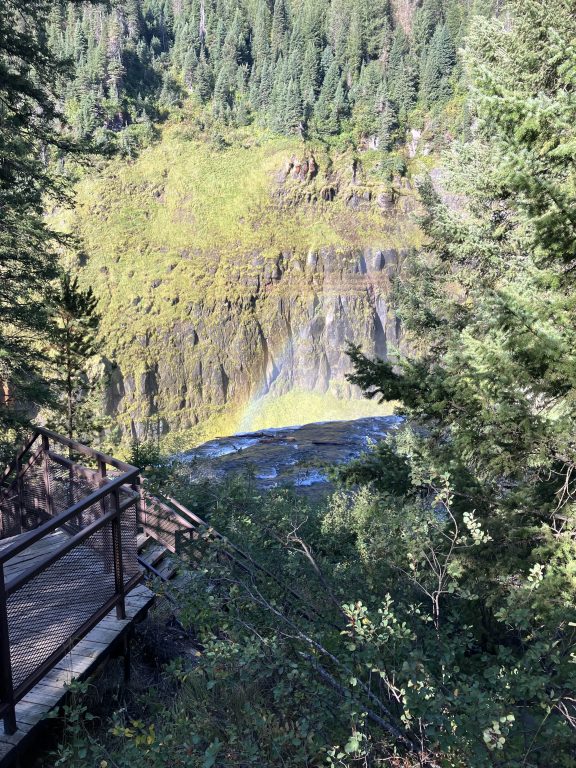
One of my favorite views so far has been Upper Mesa Falls. I had been to the area once before as part of a week-long field trip, but I was bent on visiting again once I realized just how close I was. The view was as beautiful as I remember, and I even took my dad to see it when he paid me a weekend visit.

A picture of Upper Mesa Falls taken from the boardwalk in August, 2024.
A picture of Upper Mesa Falls taken back in 2024.
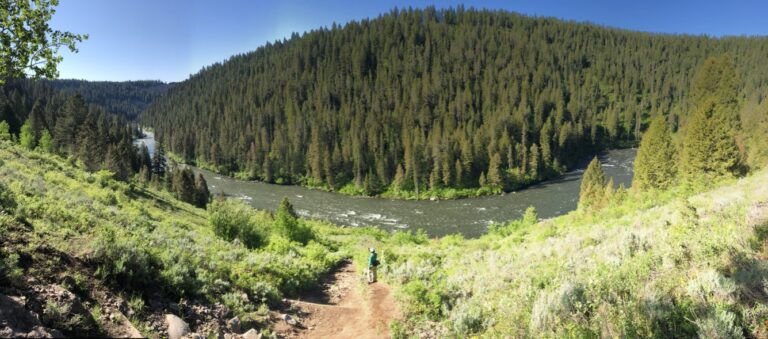
A picture of Upper Mesa Falls taken from the boardwalk in June, 2025
A picture of Upper Mesa Falls taken this June.


My philosophy for the last year-ish of my life has slowly morphed into “going wherever the water takes me” because the water has taken me some incredible places, and I would not be here without it. Coming from Eastern Montana, “wherever the wind takes me” does not hold much merit, considering the wind takes you just about everywhere. But water is deliberate. Following each river and creek has allowed me to broaden my perspective—from home turf like the Yellowstone and Beaverhead all the way to the streams of Nepal. Those are stories for another day though, or maybe if you catch me in the later half of July you might be able to squeeze one out of me! Until then, I will be meandering downstream (mostly figurative, but we interns did have an awesome Big Springs float) to wherever the water ushers me next.

Wishing you all the best,

Teddy

Facebook
LinkedIn
Pinterest

Recent Posts

A photo taken of Island Park Reservoir while standing on the dam and looking north. The sky is cloudy, Mt Sawtelle sits with little snow in the background, and the reservoir is open water (save for a few small sheets of ice in the distance).
Water Quality
Christina Morrisett

Reservoir Ices Off, Growing Season Turns On

Photo of an ice-free Island Park Reservoir taken on March 31, 2026 On March 31, 2026, with no accompanying commentary, HFF scientist Christina Morrisett stood on top of Island Park Dam and texted colleagues Rob Van Kirk and Jack McLaren photos of open water on Island Park Reservoir. Rob, eager to see that the reservoir reality matched what he was seeing in the real-time river data downstream, texted back, “Yep! That’s close enough to ice

Read More »
Photo of confluence of Warm River and Henry's Fork
Fisheries
Rob Van Kirk

Water Supply and Water Quality Predictions for Summer 2026

The photo above captures the unprecedented situation we face at the beginning of April. The photo, of the confluence of Warm River and the Henry’s Fork, was taken on February 7 and shows the shocking lack of snow we experienced in the watershed all winter as a result of record-breaking warm temperatures. How will the warm winter and lack of snow affect water supply, water quantity, and fisheries? The highlights are below. If you want

Read More »
Person holding a rainbow trout.
Water Quality
Rob Van Kirk

Water Year 2025: Everything you wanted to know and a lot more!

Every year since 2017, the Henry’s Fork Foundation Science and Technology Team has produced an annual technical report that documents all of our data collection and analysis activities for the year. Water and irrigation year 2025 was a very active year for the team, given one of the hottest and driest summers on record, our 11th year of aquatic invertebrate sampling, and the 20th year of monitoring the rainbow trout spawning run in the Buffalo

Read More »
Frequently Asked Questions
Jamie Powell

Q&A: Are We Seeing Fewer Bugs?

Are aquatic insects actually declining?  Not in the way many anglers might think. After 11 years of data collected across six sites on the Henry’s Fork, we’re seeing that overall invertebrate communities remain abundant, diverse, and comparable—or better—than other top western trout streams. In fact, key indicators show improving water quality and habitat conditions over time.   So why do hatches sometimes feel worse—especially at Last Chance? The short answer: it’s not just about insect

Read More »