Every year since 2017, the Henry’s Fork Foundation Science and Technology Team has produced an annual technical report that documents all of our data collection and analysis activities for the year. Water and irrigation year 2025 was a very active year for the team, given one of the hottest and driest summers on record, our 11th year of aquatic invertebrate sampling, and the 20th year of monitoring the rainbow trout spawning run in the Buffalo River. This blog consists only of the report’s summary, but you can download the full 70-page report here.
- Climate. Mean temperature was 3rd warmest in the 37-year record both for the water year as a whole and for the April–September period. Precipitation ended up at 84% of average for the water year and 66% for April–September, the latter being the lowest in the record. Peak snow water equivalent in 2025 was 92% of average and occurred on April 5, 7 days earlier than average. Drought conditions worsened over the year from “abnormally dry” to moderate/severe drought.
- Water Supply. Natural flow for water year 2025 was 79% of average, ranking 41st out of the last 48 water years. In the 96-year record for natural flow between Henry’s Lake and Ashton, water year 2025 came in at 80% of average, ranking 87th. Natural flow peaked earlier than average in 2025 and rapidly receded from its springtime peak to around 75% of average for most of the summer. Long-term downward trends continued: the 2001–2025 average is 16% lower than the 1978–2000 average.
- Irrigation Management. Henry’s Fork watershed diversion was 7th lowest since 1978 and 97% of the modern (2001-2024) average. Diversion was above average from April through June but below average after that due to poor water-rights priorities. Delivery to the Teton River through the Crosscut Canal was 70% of the modern average, compensated in part by exchange-well pumping that was 150% of average. Over the period of Island Park Reservoir draft, streamflow downstream of all diversions was 419 cfs on the Henry’s Fork and 45 cfs on the South Fork Teton. Variability in streamflow at these lower-watershed outflow points was among the lowest on record. Low but consistent lower-watershed streamflow contributed to carryover in Island Park Reservoir that exceeded expectations by 21,353 ac-ft, despite delivery of 10,610 ac-ft of water to American Falls Reservoir in late summer.
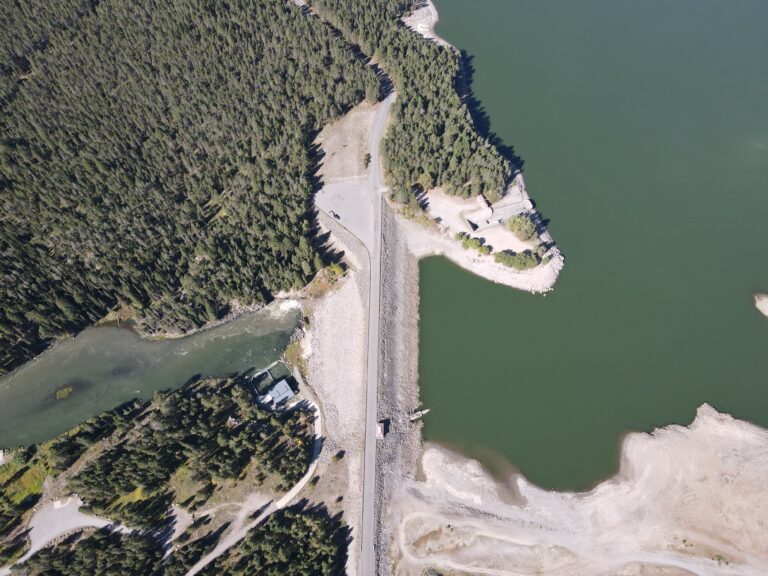
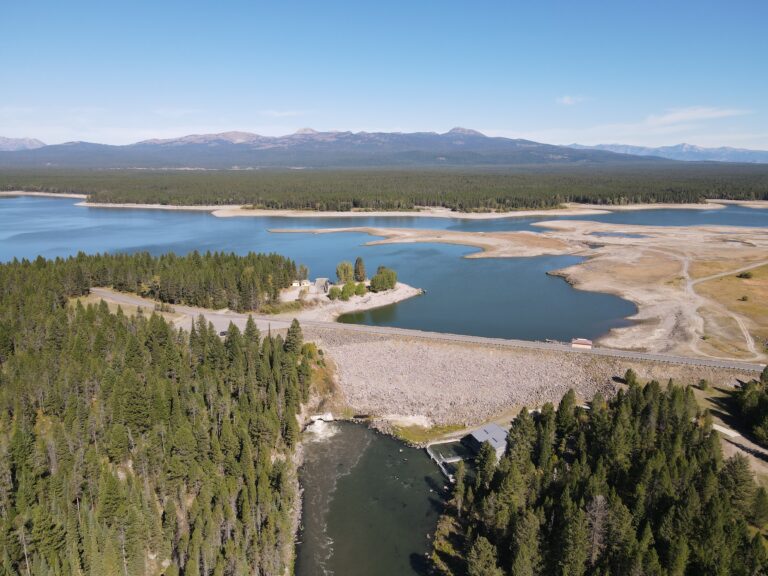
- Island Park Reservoir Management. Winter outflow from Island Park Reservoir in water year 2025 was 288 cfs, below the 1978–2024 average of 354 cfs but higher than expected based on water supply. Reservoir draft began on June 13, 19 days earlier than average, and ended on August 27, 15 days earlier than average. Minimum reservoir volume was 43,948 ac-ft (32.5% full), compared with the 1978–2025 average of 60,697 ac-ft (44.9% full). Since precision water management infrastructure and operations were first implemented in 2018 by Fremont-Madison Irrigation District, HFF, U.S. Bureau of Reclamation, and water users, minimum reservoir volume has exceeded expectations based on water supply by an average of 23,530 ac-ft, a 78% improvement. Since precision management was first implemented, winter outflow from Island Park Dam has exceeded expectations based on water supply by 100 cfs, a 36% improvement.
- Streamflow Gaging. Mean relative error of the six streamflow measurements HFF made at Island Park compared to USGS adjusted flow was 9.9%, with HFF measurements biased low by 4.5%. HFF made six measurements at Ashton, with a mean error of 2.9% relative to USGS data and a bias of 0.50%.
- Performance of Predictive Models. Our April-1 predictions overestimated natural flow by 13% at the watershed scale, a little higher than the average absolute error of 10.2% over the past nine years. The April-1 predictions also estimated that runoff timing, as measured by center of mass, would be two days later than actually occurred. The primary reason for overestimation of water supply and runoff timing was spring and summer weather that was among the warmest and driest on record. Even at that, all relevant hydrologic parameters fell within the range of statistical uncertainty for the majority of the summer. Most importantly, the April-1 model predicted that Island Park Reservoir would end the water year at 48,106 ac-ft, and the observed value was 45,569 ac-ft.
- Water Quality. Higher water temperatures, lower dissolved oxygen, and higher occurrence of harmful algal blooms have degraded water quality in Island Park Reservoir, producing high turbidity and water temperatures downstream. With another year of data in hand, watershed-wide natural streamflow is the single best predictor of turbidity at Island Park Dam, which was highest in our 12-year record in 2025. Summer water temperature is best predicted by reservoir drawdown and air temperature. At the watershed scale, turbidity is increasing at around 4% per year, and summer water temperature is increasing at 1.6°F per decade, but dissolved oxygen concentrations are high and showing no change.
- Aquatic Invertebrates. Based on 11 years of sampling at six different locations, invertebrate communities in the Henry’s Fork are abundant, diverse, and dominated by mayflies, stoneflies and caddisflies (EPT taxa); are as good or better than on other western trout streams; and are as good or better than they were on the Henry’s Fork decades ago. The Hilsenhoff Biotic Index (HBI) indicates good to excellent water quality from headwaters to St. Anthony, with little evidence of pollutants. Most of the invertebrate community metrics we assessed were best explained by location on the river, with little to no dependence on streamflow or water quality. Total invertebrate abundance and Pale Morning Dun abundance have decreased significantly since 2015, but HBI, %EPT, and EPT taxa richness have all improved significantly since 2015, indicating improvement in water quality and aquatic habitat and replacement of non-insects with more desirable EPT species. Decreased dry-fly fishing quality at Last Chance/upper Ranch over the past decade is likely due to a combination of lower trout populations, increased turbidity, and altered mayfly emergence behavior due to warmer temperatures, not to decreased insect numbers. There is no evidence that trout populations are limited by invertebrate numbers. In addition to our annual sampling in 2025, we conducted an online survey for anglers. We received 104 hatch observations from 47 individuals between March 20 and October 9. Of these, 72% occurred in May and June, with over half of the observations coming from Ashton Dam to Chester Dam and from the north boundary of Harriman State Park to Riverside. Across the 104 river visits, there were 288 total observations submitted, including observations of no hatch. Blue Winged Olive and Pale Morning Dun mayflies and Mother’s Day and Spotted Sedge caddisflies were the most frequently observed species, and diversity of observed species increased with distance downstream, as predicted by the River Continuum Concept and observed in our benthic samples.
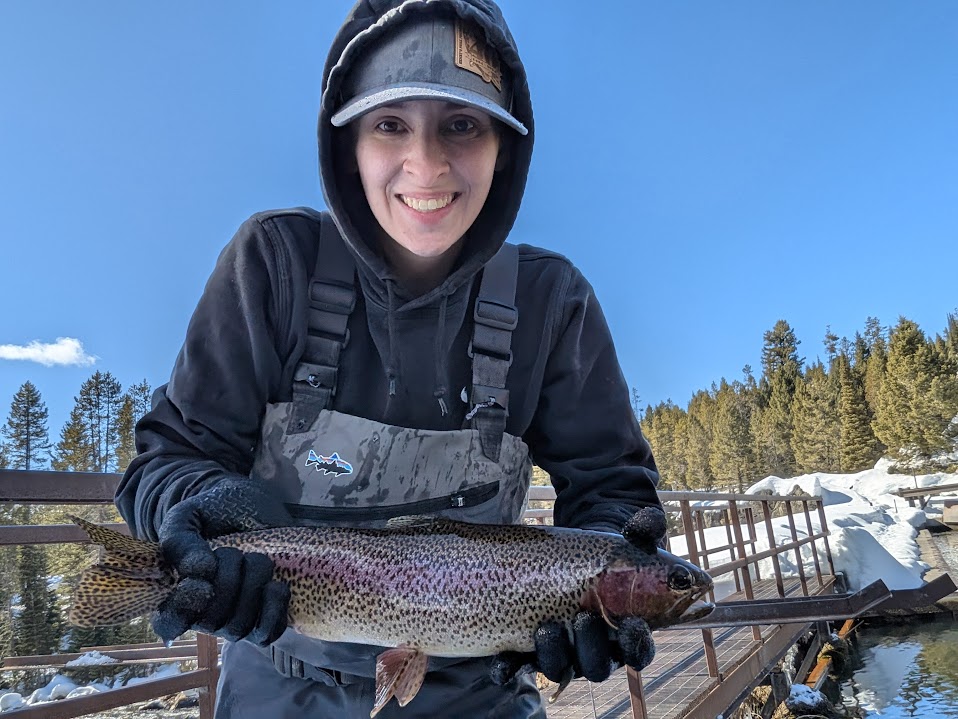
- Buffalo River Fish Ladder. In 2025, HFF conducted the 20th year of monitoring fish passage through the reconstructed Buffalo River fish ladder. Annual March 1–June 15 passage of spawning-sized (11.8 inches or greater) Rainbow Trout ranged from 88 to 748 fish, with an average of 247. Median migration date ranged from April 13 to May 20, but most years clustered between mid-April and early May. Rainbow Trout dominated captures throughout the record, although Brook Trout and several other species were also recorded. The number of spawning-sized Rainbow Trout depended strongly on a Box Canyon winter flow index that integrates the effect of winter flow on trout recruitment over all preceding years that contributed cohorts of spawners. The fitted regression model explained 59.7% of the interannual variation in annual spawner abundance. The monitoring record indicates that the Buffalo River fishway provides functional upstream passage but that annual variation in spring spawners is consistent with a population that is limited by winter flow in Box Canyon.
Download the full report here.