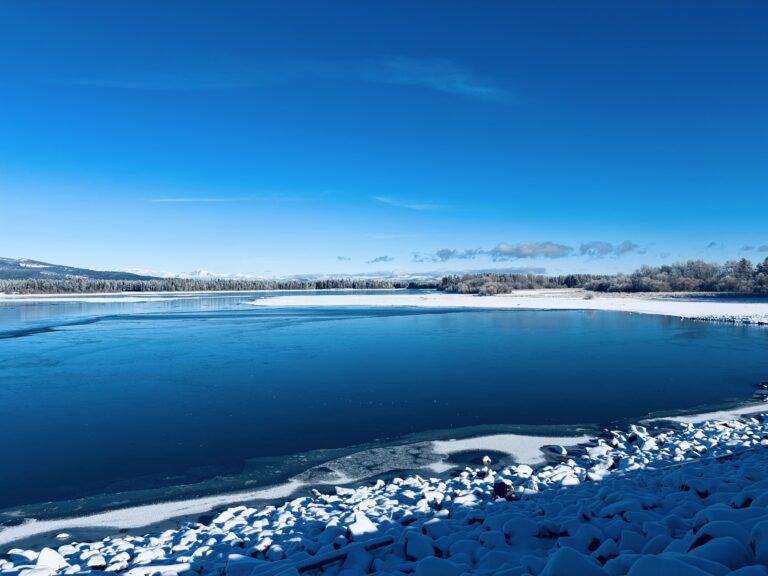
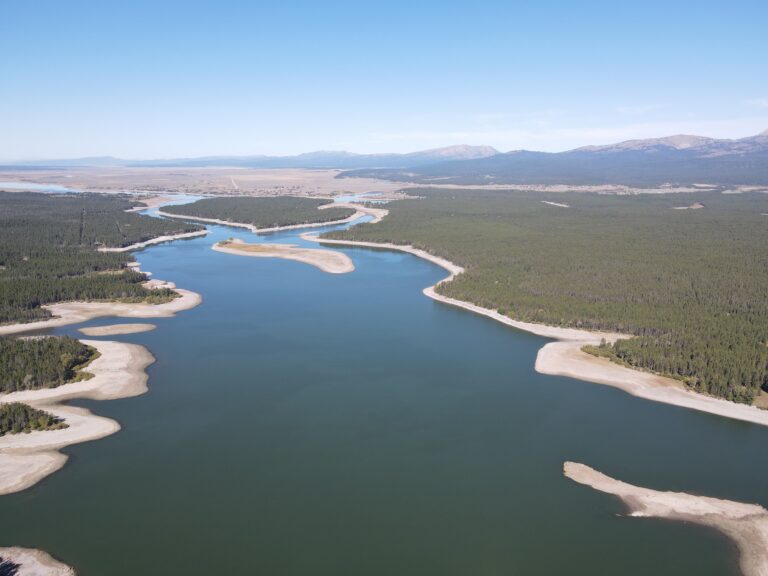
Photo of an ice-free Island Park Reservoir taken on March 31, 2026
On March 31, 2026, with no accompanying commentary, HFF scientist Christina Morrisett stood on top of Island Park Dam and texted colleagues Rob Van Kirk and Jack McLaren photos of open water on Island Park Reservoir. Rob, eager to see that the reservoir reality matched what he was seeing in the real-time river data downstream, texted back, “Yep! That’s close enough to ice free for the purposes of calculating reservoir evaporation. Water quality signature shows substantial atmospheric influence.” Jack, the foremost expert on all things Island Park Reservoir, responded with a single word, “Brutal.”
The Henry’s Fork Foundation has been monitoring water quality in Island Park Reservoir since 2017. During the open water season, typically May through October, HFF staff navigate to five reservoir locations to collect data like water temperature, dissolved oxygen, and turbidity from the reservoir surface to the reservoir bottom. This monitoring effort allows HFF to “see underwater” to map in-reservoir fish habitat, track lake dynamics, and forecast the temperature and turbidity of dam outflow to the Henry’s Fork downstream. The project has become routine. We know when to prep the boat, when to calibrate equipment, and when to assign staff time. But in 2026, HFF experienced a first in almost ten years of monitoring: Island Park Reservoir ice free in April.
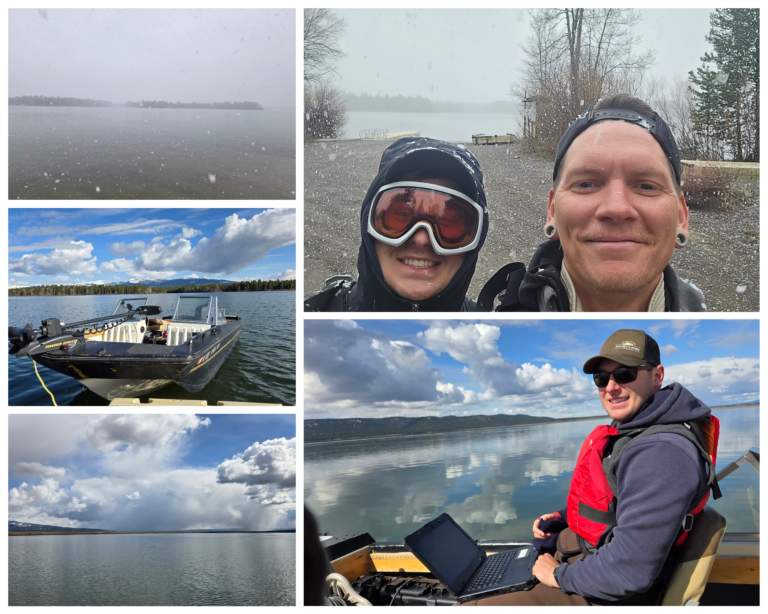
So, we got the boat running and rallied the troops and successfully started our field season a month earlier than usual. On Wednesday, April 8, 2026 we embarked on our first Island Park Reservoir field mission of the year.
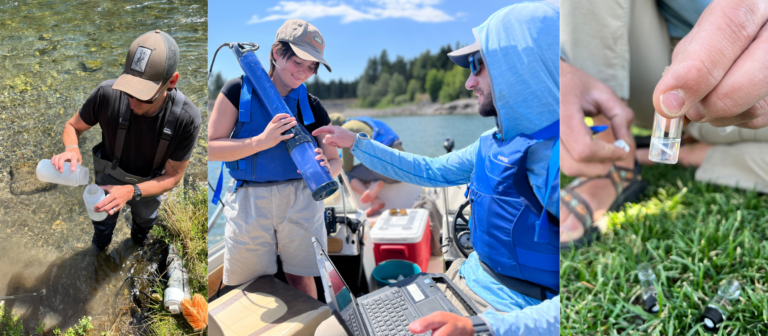
A collage of photos taken during reservoir monitoring on April 22 and April 29, 2026.
Here, we answer your questions and document what happened, what we learned, and what we forecast for the summer ahead. We also connect you with resources to stay up-to-date with water quality conditions to inform your day on the water, whether boating on Island Park Reservoir or fishing the Henry’s Fork downstream.
Read on to find the answers to:
Why did ice melt on Island Park Reservoir a month earlier than usual?
How does ice melt timing impact water quality in Island Park Reservoir?
What did we learn from monitoring Island Park Reservoir in April?
What does an early ice-off on Island Park Reservoir mean for the summer ahead?
Why did ice melt on Island Park Reservoir a month earlier than usual?
In a standard winter, Island Park Reservoir is covered with a layer of ice 30–40 inches thick and an additional layer of snow sitting like frosting on top. With its shiny white surface, the snow layer acts as a reflective barrier between reservoir ice and sunlight. The snow layer melts first and reveals the dark ice layer beneath. Ice then absorbs sunlight, warming the water beneath. Warm reservoir water slowly eats away at the ice layer, from the bottom to the top, until the reservoir is eventually ice free. With thick layers of snow and ice, the ice melt process takes significant time and is resilient to short warm spells and even a warm spring season.
But with an extremely warm and dry winter, Island Park Reservoir didn’t develop a strong ice layer—and didn’t have the thick, insulating snow layer to protect ice from sunlight. In fact, the ice fishing season on Island Park Reservoir was rather short and snowmobilers were reportedly breaking through ice as early as February. Unfortunately, with minimal snow cover and an underachieving ice layer only 18–20 inches thick, Island Park Reservoir was prone to melting in a week’s time.
Photo of Island Park Reservoir taken on December 3, 2025. The reservoir is mostly ice free.
How does ice melt timing impact water quality in Island Park Reservoir?
When the reservoir is covered in ice, the coldest water sits at the reservoir surface and the warmest water rests at the reservoir bottom. But once that ice melts, the cold surface water plunges down and the warm bottom water swims up—an event known as lake turnover. Lake turnover does two things:
It mixes the reservoir so it’s mostly the same from top to bottom.
It brings an influx of nutrients from the reservoir depths up to the surface.
With a rush of sunlight and nutrients, the growing season for the entire reservoir ecosystem begins. Algae grow like a green lawn, zooplankton graze like deer, and trout and kokanee roam like predators on the savannah. Here, the reservoir ecosystem is balanced.
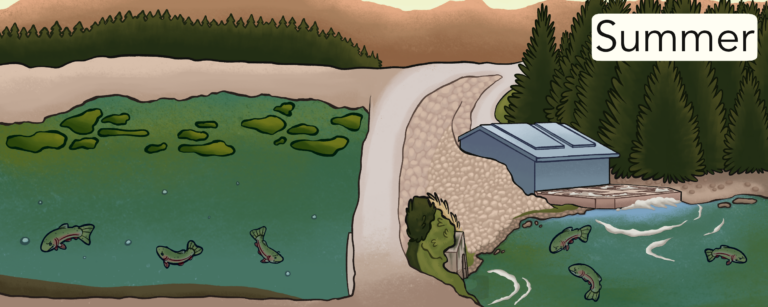
But dynamics change when nutrients run out and the reservoir warms up. Cyanobacteria—the organisms responsible for toxic or Harmful Algal Blooms (HABs)—grow like weeds in a garden. Slowly, cyanobacteria cycles take over. The reservoir turns shades of green and blue-green at the surface. Bacteria die, turn brown, and sink to the bottom. Then brown-tinged water is exported out of Island Park Dam and downstream to the Henry’s Fork.
This green-brown growth-death cycle happens every year. And it typically happens in late July and early August for a handful of weeks. But warmer and drier conditions year-round are extending the growth-death cycle to occur earlier and for longer.
Illustration by Teddy Montalvo of summertime algae dynamics both in Island Park Reservoir and the Henry’s Fork downstream.
What did we learn from monitoring Island Park Reservoir water quality in April?
With ice melting on Island Park Reservoir a month earlier than usual, reservoir conditions are also a month ahead. April looked like what we typically see in May and early June.
In addition to algae getting an extra month of sunshine and growth, Island Park Reservoir is already starting to stratify. This means that the reservoir is developing a strong warm surface layer on top of a distinct cold bottom layer. Thankfully, cooler and wetter weather in April slowed the warmth of the reservoir surface.
But early development of a deep cool pool in a year as warm and dry as 2026 does not bode well for the cool pool’s lifetime. Runoff is over, so there is no cool water left to buffer and expand the deepwater cool pool. The data are already showing that the cool pool is warming—3ºF in just four weeks. And since the dam pulls water from the bottom of the reservoir, what is left of the cool pool will be quickly exhausted once irrigation demand calls for water to be sent downstream.
Brady Tappana, HFF Field and Lab Technician, manages the laptop during water quality monitoring on Island Park Reservoir. Photo taken on April 29, 2026.
What does early ice melt on Island Park Reservoir mean for the summer ahead?
When it comes to water quality on Island Park Reservoir and the Henry’s Fork downstream: since April looked like May, July will likely look like August. Everything is happening a month ahead of normal This means high turbidity and warm water will come out of of Island Park Dam earlier in the season.
High turbidity. Days will get longer from now until the summer solstice. Thus, Island Park Reservoir and the algae and cyanobacteria that call it home are getting far more sunshine than usual. This means we can expect more growth and more death starting earlier in the season. This will result in higher turbidity downstream and more harmful algal blooms in the reservoir—possibly by mid-June.
Warm water. The small deep cool pool near the dam is already warming up and whatever is left will be depleted rapidly. This summer, HFF predicts we will either see 1) a short peak with record high water temperatures coming out of Island Park Dam or 2) a long period with warmer outflow.
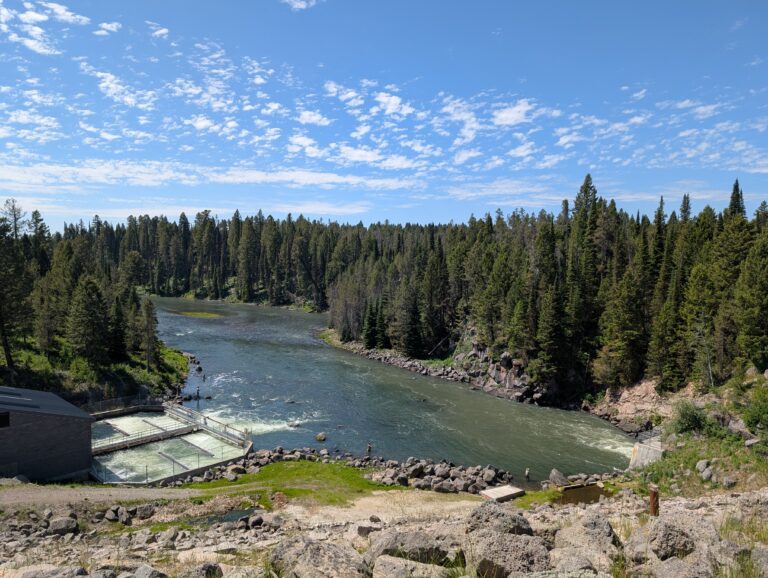
Photo of outflow from Island Park Dam taken on June 19, 2025. There is a plume of turbid water from the algae growth-death cycle flowing out of the dam gates (right side of photo).
Well, this seems like pretty terrible news. Is there any way out of this?
In the short term, unfortunately, no. Conditions in Island Park Reservoir reflect the last year of weather—that’s a lot of inertia. Although a cool and wet summer could slow the reservoir’s water quality inertia, it is highly unlikely and, even then, not a total cure.
In the long term, yes. Our plan to Develop Infrastructure to Reduce Temperature and Turbidity (DIRTT) is already underway. Using a portion of our $1.1 million in federal WaterSMART funds and a $100K matching grant from the Chrysanta Foundation, we are currently working with an engineering consulting firm to investigate mechanisms for keeping algae growth-death cycles in check. Careful research and design are key before moving on to implementation. Solving this problem will take time, but that’s why we’ve already gotten started.
Ice melted on Island Park Reservoir a month earlier than usual due to a warm and dry winter.
Early ice melt exposes the reservoir ecosystem to sunlight for longer—giving algae and cyanobacteria in the reservoir extended time in a growth-death loop, increasing turbidity earlier in the season.
HFF expects water quality conditions to be a month ahead of what we typically experience in Island Park Reservoir and the Henry’s Fork immediately downstream through Box Canyon and the Ranch. April looked like May, so July will likely look like August.
On the Henry’s Fork: We expect warm dam outflow and high turbidity as early as mid-June.
On Island Park Reservoir: We expect low reservoir levels, more boating hazards, and an earlier onset of harmful algal blooms (HABs).
Special thanks to Joe Hively for taking photos during April field missions and to Dr. Jack McLaren for providing the background for this blog post.
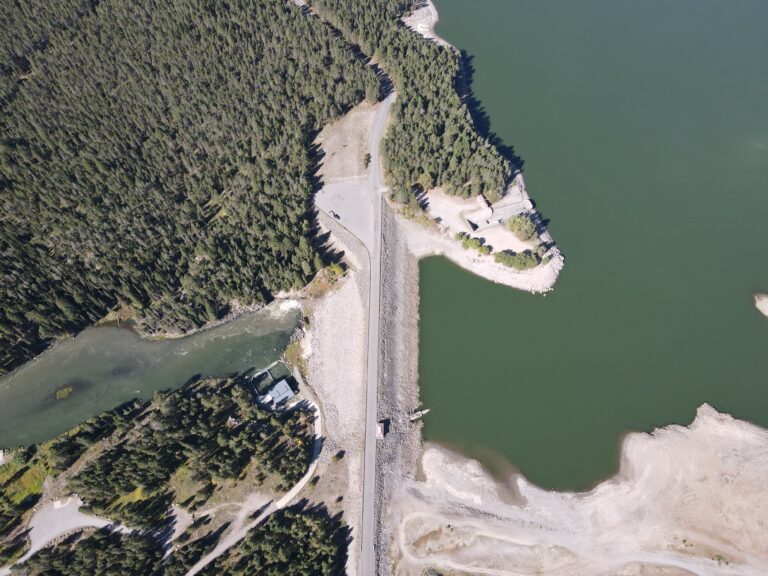
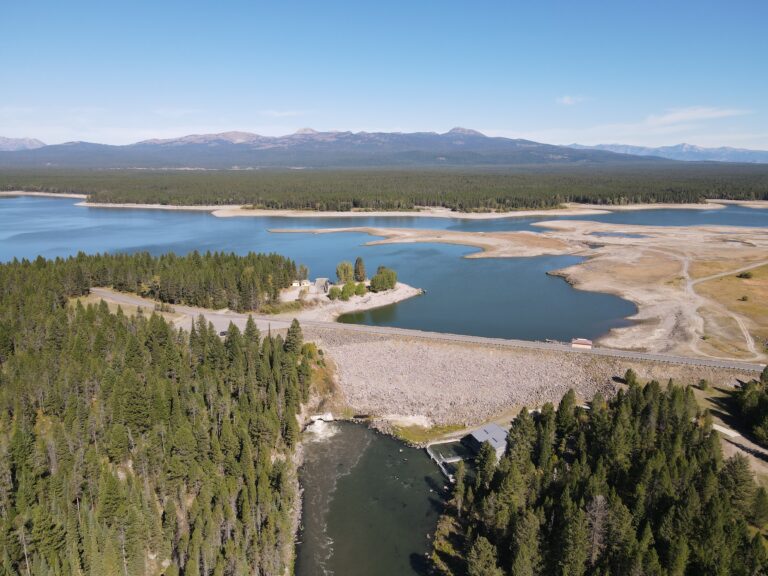
Drone photo of Island Park Dam taken on September 9, 2026 Looking Back on September September brought lows and highs to Island Park. Island Park Reservoir started September at 29% full and quickly fell to a low of 12% full on September 19. The rapid drawdown of the reservoir was the result of managers needing to move water downstream to American Falls (to irrigate farms in the Magic Valley with senior water rights). Such low
This story was written by Audrey Hunter (2026 intern) and was originally published in the Fall 2026 Newsletter. It’s no secret that late summers on Island Park Reservoir haven’t been in perfect conditions in recent years. Warm, turbid, algae-filled water plague reservoir recreationists while diminishing water quality downstream. Cyclical algal blooms decrease water clarity and create less-than-ideal circumstances for the reservoir’s flora and fauna. What’s the solution? HFF’s DIRTT Plan. In-Reservoir Oxygenation Nutrients released from
Drone photo taken on September 9, 2026 The Henry’s Fork Drought Management Planning Committee met on Wednesday, September 16 2026 to develop an updated reservoir management strategy. Downstream of the Henry’s Fork watershed, lower-valley irrigation demand over the rest of the season is anticipated to be slightly lower than projected last week, so Island Park Reservoir and Grassy Lake (in the Fall River drainage) do not need to deliver any more water out of the
This year has brought the Henry’s Fork watershed an extraordinary water-supply challenge. Natural flow is exceptionally low, and Island Park Reservoir is ending the summer at a near-record low level. But there is another important part of this story: we knew these conditions were coming, we planned for them, and water managers are managing the water we have as carefully as possible. HFF is one of the 6 official signatories to the Henry’s Fork Drought