This is the 3rd blog in a series about research and conservation activity in the Upper Henry’s Fork, focusing on improving water quality on Island Park Reservoir. Click here for part 1 and here for part 2.
Now that we have talked about how Island Park Reservoir works and what makes it different from other reservoirs, it really comes down to the question of can we increase oxygen, decrease temperature, and improve water clarity?
What is HFF currently doing to minimize temperatures and turbidity?
The good news is that for the past 7 years HFF has been having a measurable impact on water quality issues downstream of Island Park Reservoir and in the reservoir itself.
- Reducing drawdown through HFF’s Precision Water Management and Farms and Fish programs: On average, Island Park Reservoir is only about 45% full at the end of every year. HFF’s Precision Water Management and Farms and Fish programs helps to reduce outflow, sending water through the power plant rather than the gates. This is a good thing, becuase water that goes through the gates tends to be less clear than water that goes through the power plant. This minimizes the amount of suspended material that is exported outside of the Reservoir.
- Keeping as much water in Island Park Reservoir as possible: Keeping water in Island Park Reservoir helps to reduce mixiing within the reservoir, prevents suspended material from being transported to the dam, and improves water quality overall.
- Springtime freshet: A springtime freshet is where a large rush of water is released, simulating what would naturally occur during snowmelt. This rush of water is strong enough to export fine sediment out of the river. Learn more about a freshet here.
What is HFF working on next?
Earlier this year, HFF submitted a $1 million federal grant to the US Bureau of Reclamation to partially fund the new DIRTT Plan (Developing Infrastructure to Reduce Temperature and Turbidity). Just this week, we got word⏤we were APPROVED!
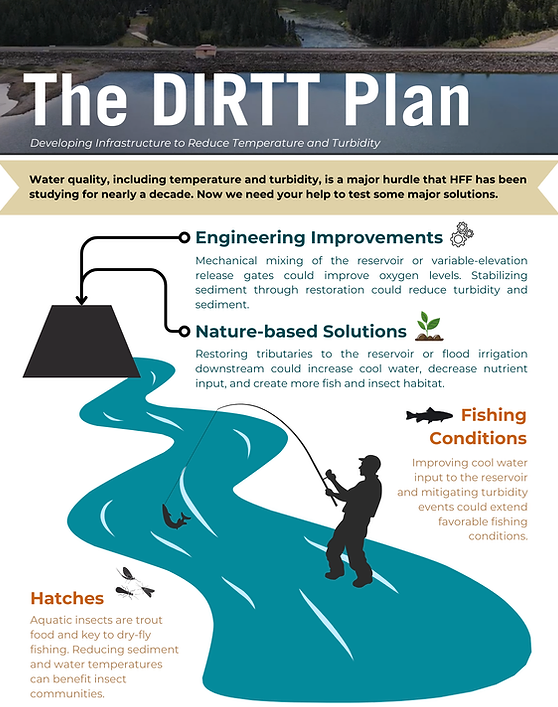
DIRTT Plan:
- The DIRTT plan is a new effort to develop infrastructure to reduce temperature and turbidity in Island Park Reservoir and the Henry’s Fork. We will be using natual and engineered means to accomplish the following:
- Reduce nutrient concentrations and stabilize sediment
- Prevent movement of poor water quality from Island Park Reservoir into the river downstream
The DIRTT plan will start by evaluating the cost and efficacy of multiple individual strategies given the unique needs and circumstances that surround Island Park Reservoir.
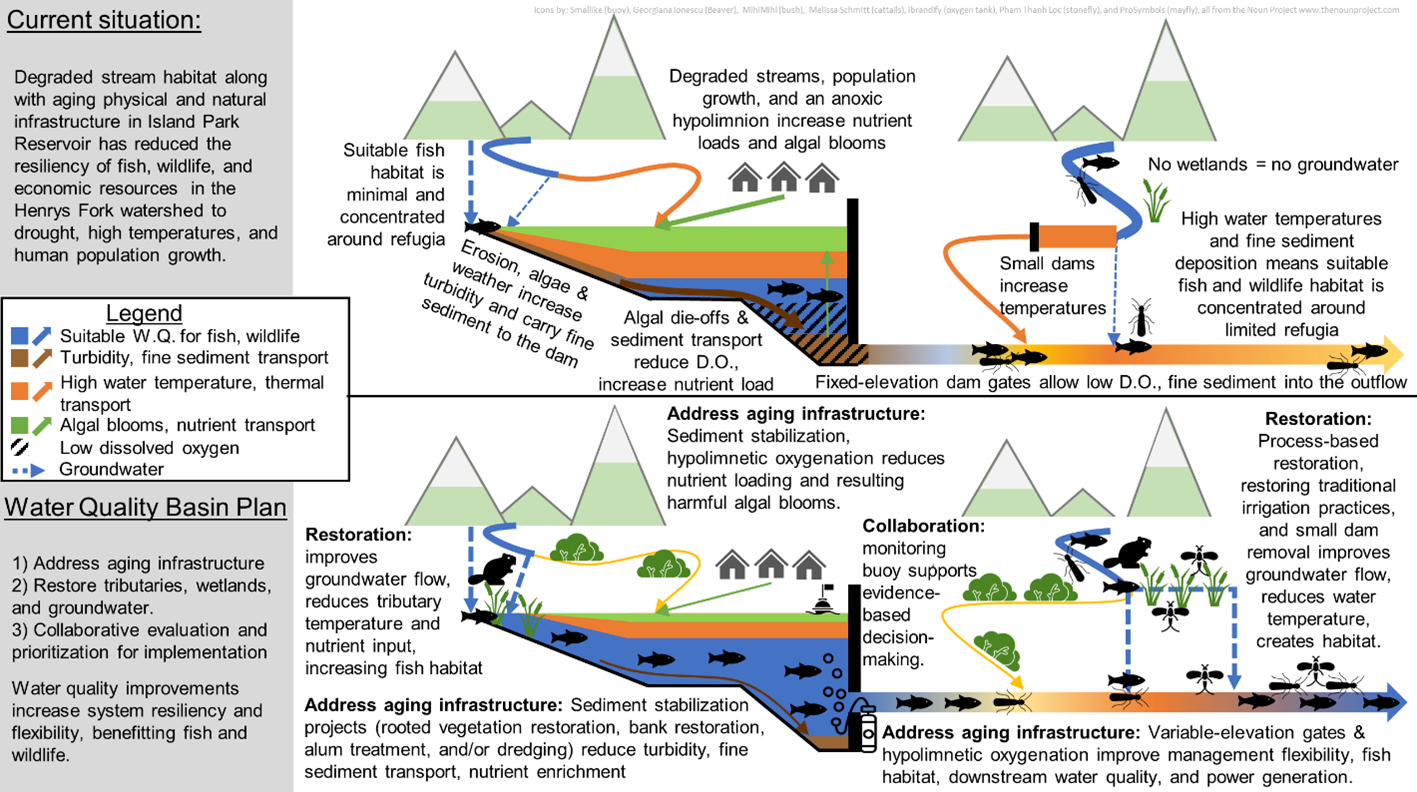 Conceptual diagram of DIRTT plan strategies to improve temperature and turbidity in the Henry’s Fork watershed.
What will DIRTT actually do?
Efforts to improve Island Park Reservoir’s long-term water quality outlook could be accomplished by reducing phosphorus input from the watershed into the reservoir through:
- The stabilization of sediments and phosphorous removal
- Aeration (the oxygenation of deep waters)
- Bank erosion control – planting shrubs and trees to help stabilize the bank
HFF is committed to exploring every potential option as part of the DIRTT plan. In the right circumstances, this menu of options can be used separately or together to accomplish our goals by improving water clarity and dissolved oxygen concentrations. Many of these strategies can accomplish multiple goals at once. Aeration, for example, has been used for decades in hundreds of lakes worldwide to both directly increase fish habitat and reduce nutrient concentration and algal blooms.
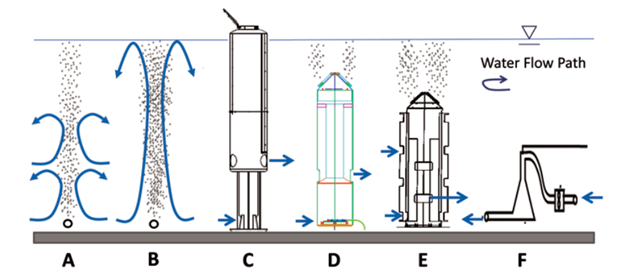
Examples of lake oxygenation infrastructure. (A) line diffuser with low enough gas flow to maintain stratification, (B) line diffuser with high enough gas flow to prevent stratification, (C) traditional full-lift hypolimnetic aeration, (D) submerged partial-lift hypolimnetic aeration, (E) depth-selective layer aeration, and (F) conical oxygen contactor, aka “Speece Cone.” from Moore et al. (2015).
Aquatic vegetation plays a key role in reservoir resiliency
 Rooted Aquatic Plants (summer 2024)
Each of the DIRTT plan’s strategies, alone or in combination, ultimately aims to reduce nutrient concentrations in Island Park Reservoir and stabilize sediments. This would improve water clarity and encourage aquatic vegetation growth.
The roots of aquatic vegetation are very effective at further stabilizing sediments, absorbing nutrients, and preventing algal blooms, making the water even clearer, fish habitat better, and encouraging even more vegetation growth. This beneficial feedback loop would increase the resiliency of Island Park Reservoir to random weather events or future changes and stressors as our beautiful corner of the world becomes ever more popular.
But, what if poor water quality continues?
The second goal of the DIRTT plan aims to prevent or reduce movement of poor water quality from Island Park Reservoir into the river downstream. The Henry’s Fork Foundation already works collaboratively with Fall River Rural Electric Cooperative to reduce turbidity in the river downstream, but the DIRTT plan aims to explore other strategies.
One idea is to explore retrofitting the reservoir’s outflow works and operational practices to allow more flexibility. Currently, reservoir outflow comes from two static points within the reservoir. At times, water quality is good throughout most of the water column but is poor near one or both of the outflow points. Allowing outflow points to be movable is one way to allow managers to selectively withdraw optimal water quality into the river downstream.
 Example of a variable-elevation outflow infrastructure on a dam, which would allow managers to selectively withdraw optimal water quality into the river downstream. Adapted from Sherman, 2000.
That sounds great, but will DIRTT actually work?
The Henry’s Fork Foundation’s Voice of the River program is already giving voice to concerns about water quality and working with agencies and partners to mitigate nutrient inputs from sewage treatment. The DIRTT plan will continue to build upon these efforts. The pace of development in the Island Park Reservoir watershed along with a changing climate creates challenges. Thankfully we’re not alone so we don’t need to re-invent the wheel.
Lots of communities throughout the western U.S. (and beyond) have successfully reduced nutrient input to their local waterways through collaborative action. In Idaho, excess nutrients were threatening recreation and fishing resources in Coeur D’alene Lake. Harmful algal blooms were preventing swimming and fishing was suffering. A lake and nutrient management plan has resulted in reductions in nutrient load and improvements in water quality through sewage treatment, remediating old mines, and working collaboratively across agencies and landowners to fund projects that removed nutrient inputs resulting from residential, ranching, and agricultural areas.
DIRTT can result in more good fishing days!
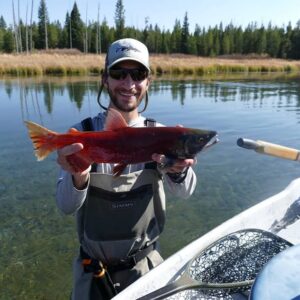
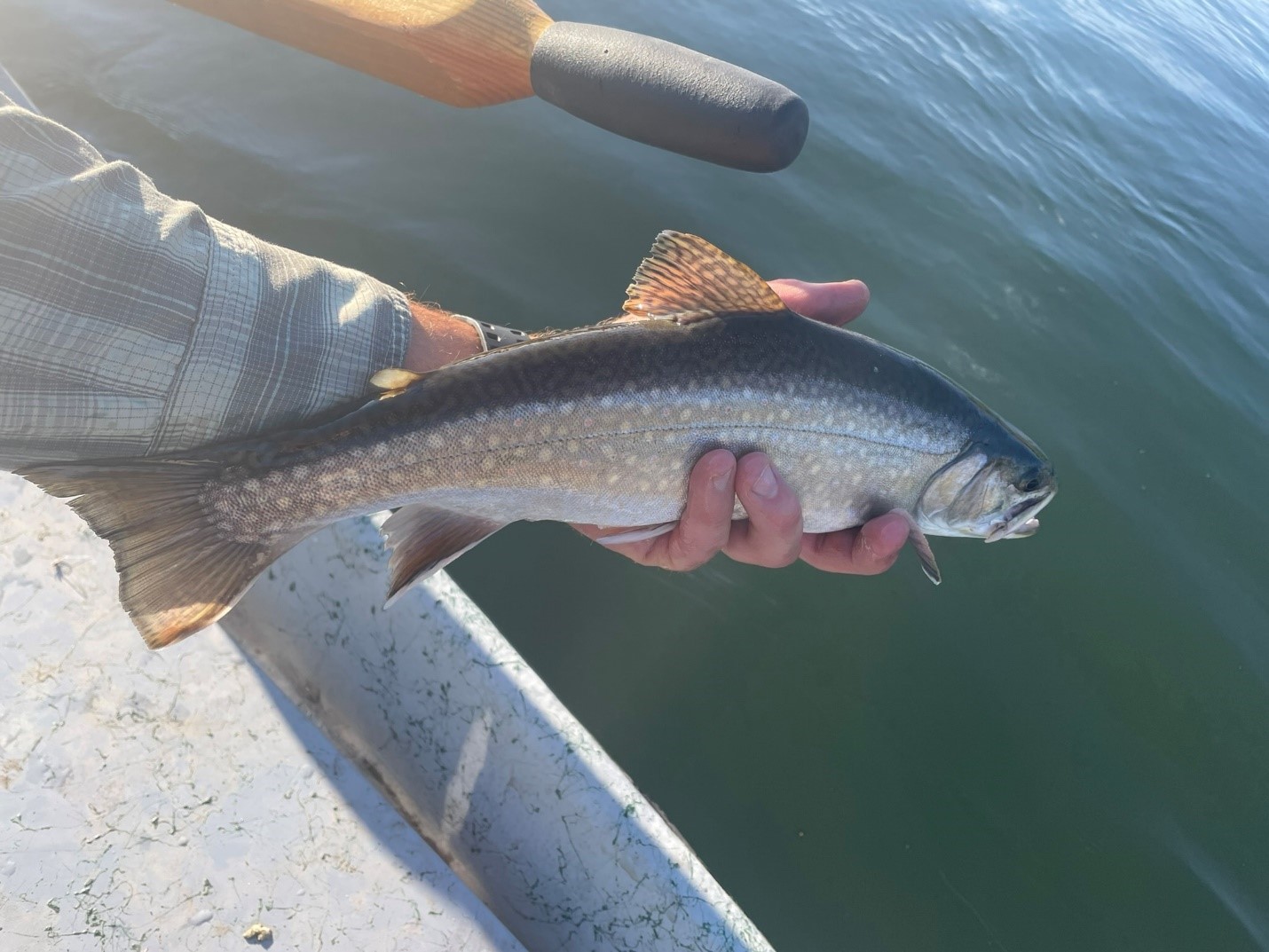 A wild brook trout caught in August 2024 in Island Park Reservoir. The fish was spotted chasing baitfish along the weed edges and eagerly took a streamer stripped near the surface. <photo by the author>
The wind storm this past June (2024) led to the establishment of huge areas of submerged vegetation throughout the reservoir. These submerged rooted aquatic plants (macrophytes) provided excellent fish habitat and some of the best fly-fishing I’ve had the pleasure of experiencing on Island Park Reservoir! Finding weeds meant finding fish!
Looking to the future
The great thing about science is that it’s all about testing theories and learning as much as possible. Even when something doesn’t work, it’s a learning experience that we can take with us as we work hard to protect this invaluable resource that we all love so much.
Whether you’re interested in how Island Park Reservoir works or not, I hope I’ve made an impression. Island Park Reservoir is worth our care and concern. If we as a community work to improve water quality in Island Park Reservoir, I see enormous potential to improve fishing and recreation in the Reservoir and its outflow, the Henry’s Fork River.
Island Park Reservoir has shown us time and again that there is a glimmer of hope to re-establish a vision of the past: clear, oxygenated water in the reservoir and downstream, fisheries of red salmon in the Henry’s Fork, gulper action amongst the weeds and springs of the west end and McCrea arm, recreational opportunities, and water quality.