As it is the afternoon of December 31, I am closing the year with my annual fish-of-the-month blog, this one at the end of my 11th year of catching a fish in my home waters in each month of the year. To spare you the math, that’s 132 consecutive months of catching a wild trout or whitefish (and in some years I’ve fair-caught suckers and shiners, too) within a three-hour drive of my home in Ashton.
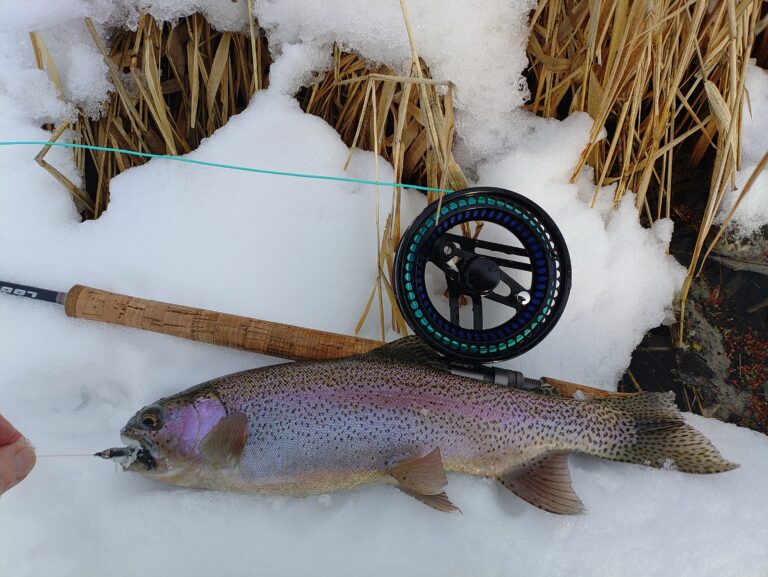
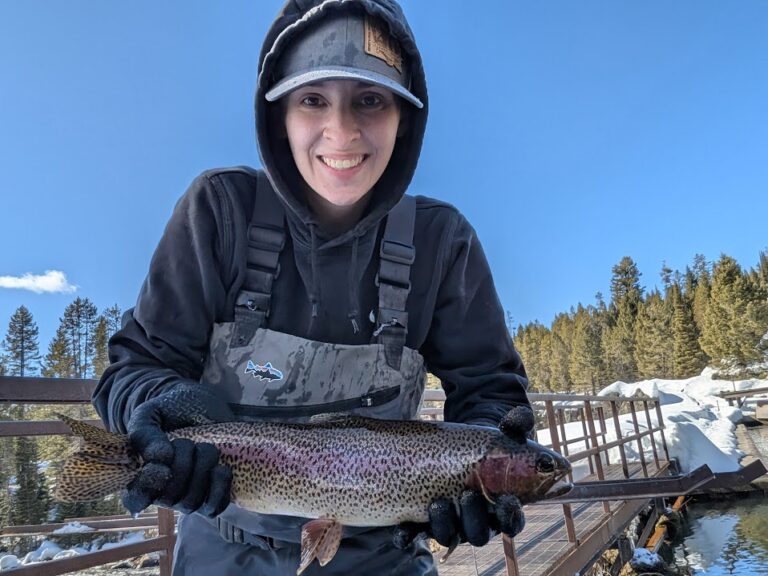
First fish of 2025, caught on the morning of January 3.
As in 2024, I set some constraints on allowable fishing methods to limit my impact on the fish, limiting myself to only two methods of fishing: 1) a single streamer, wet fly or skater fished on a spey rod (in my case, a Loop 11′ 4-weight switch rod), or 2) a single dry fly. I used a couple of different 5-weight rods for the latter, including a Winston 8 1/2 foot, slow-action rod that Mike Lawson gave me as a bonus at the end of the 1984 season at Henry’s Fork Anglers.

Last year’s salmonfly shucks underneath a rock in the Warm River to Ashton reach, January 3, 2025.
Some things are constant from year to year, such as fishing primarily between Warm River and Ashton during the winter, while other things change depending on weather, work obligations and non-fishing activities, and luck. As it turned out, I fished far fewer times in 2025 (18) than in 2024 (38) and also spent far fewer hours fishing (35.5 hours total in 2025 vs. 106 hours in 2024).

No fishing today! January 21 near the Jumpoff Canyon access, during the only extended period of ice cover of 2025.
However, due to being in the right places at the right times and/or to improved experience and fly choice with the spey rod, I caught 69 fish in 2025 vs. 65 in 2024, for a catch rate of 1.94 fish/hour in 2025. That’s comparable to the catch rates I used to achieve fishing primarily with dry-dropper and indicator nymph rigs! However, even with higher catch rates, fishing a single streamer on a spey rod or a single dry still reduces impact by reducing the incidence of foul hooking and deeply hooked fish.

February fish, Stone Bridge.
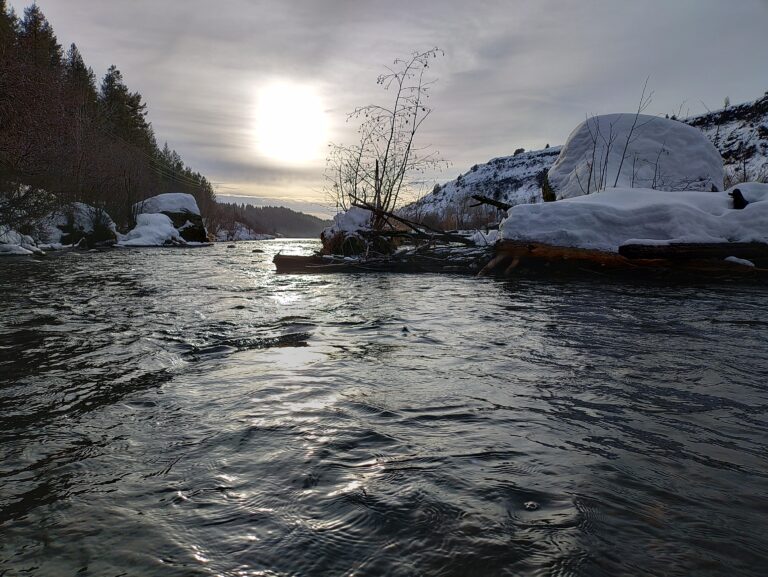
Typical winter afternoon at Stone Bridge.
Over the course of the year, I caught fish on both the trout spey and dry rods in January, June, and October; on the spey rod only during February, November and December; and on dry flies only in March, April, May, July, August, and September.

March 2 on Warm River, where I caught a small rainbow that I saw rising to midges in this pool.

First caddis hatch of the year, April 19.
One thing that stayed the same in 2025 was the amount of time I spent taking other people fishing, primarily my brother Joe, who can’t get out on his own and is limited to trips of less than 4 hours due to health issues. In all, I took Joe and other folks fishing 13 times for a total of 46.5 hours.

Joe with a nice rainbow taken on a Green Drake at the Fun Farm, June 17.
One difference between 2025 and recent years is that I spent more time fishing tributary streams, catching fish in each of Warm River, Robinson Creek, Fall River and Teton River in 2025.

Nice brown trout taken on an old-school elk-hair Henry’s Fork Hopper on Robinson Creek, July 6. That is the 1984-vintage Winston that Mike gave me, along with an early-80s Hardy Perfect reel.

Robinson Creek, July 6.
One interesting statistic from 2025 was that I spent more hours working on the river (98 hours) than I did both fishing and taking others fishing (82 hours). Although I have combined work and fishing in previous years, this year’s work outings were 100% work, although some of the fishing time counted as work, since I will often use fishing as a good excuse to look at conditions on the river firsthand and talk with guides and other anglers.
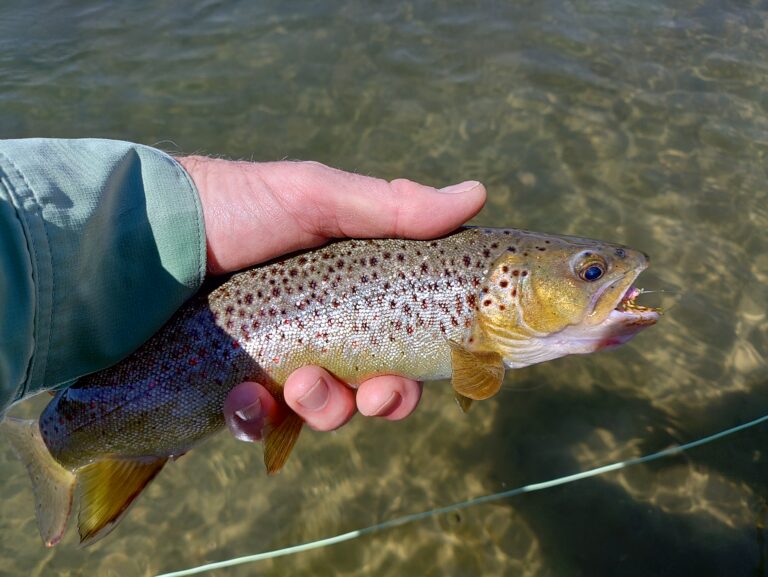
A fat brown trout from the lower Teton River, taken on a modern foam hopper, August 10.
On one particular day, Joe and I chose to fish Box Canyon, even though I knew the water would be too dirty to fish effectively, as we had been carefully monitoring and studying record-high turbidity at Island Park Dam all summer. As expected, we did not catch any fish, but the experience solidified what I already knew from the numbers, namely that the Box Canyon, Last Chance, and Ranch reaches were essentially unfishable for eight weeks last summer due to poor water quality. The good news is that we fully understand the mechanisms that create poor water quality and have identified some potential engineering solutions via the DIRTT plan to solve the problem. The bad news is that the solutions will be very expensive, require collaboration from numerous partners, and take a long time to plan and implement.

Even with high turbidity, Box Canyon on August 9 was still scenic. It was also very peaceful because very few people were out fishing.
No record of 2025, whether it be from fishing or from the millions of data points HFF collects and analyzes each year, would be complete without mention of just how warm and dry it was. I’ll provide the quantitative details in another annual blog, namely the 2025 technical report and water year review that will come out in January, but suffice it to say here that “winter” was very short in 2025, essentially amounting to January through March. Spring was just April and May, and by late July, we were already into what has become a very extended period that amounts to “late summer”. That used to be a fleeting few weeks in August that rapidly turned into fall by Labor Day but now seems to last well into October.

Hungry brown trout Joe caught on a hopper at Vernon Bridge, September 20, during the new extended season of “late summer.”
As a result of high water temperatures and high turbidity we now routinely see below Island Park Dam from late June through late August, I now do most of my fishing on the Ranch during September and October. In 2025, I caught all but a few of my September and October fish on the Ranch and experienced some excellent hatches and full afternoons of as many rising fish as I wanted to fish to.

Hatch of tiny blue-winged olives on the Ranch, September 21.
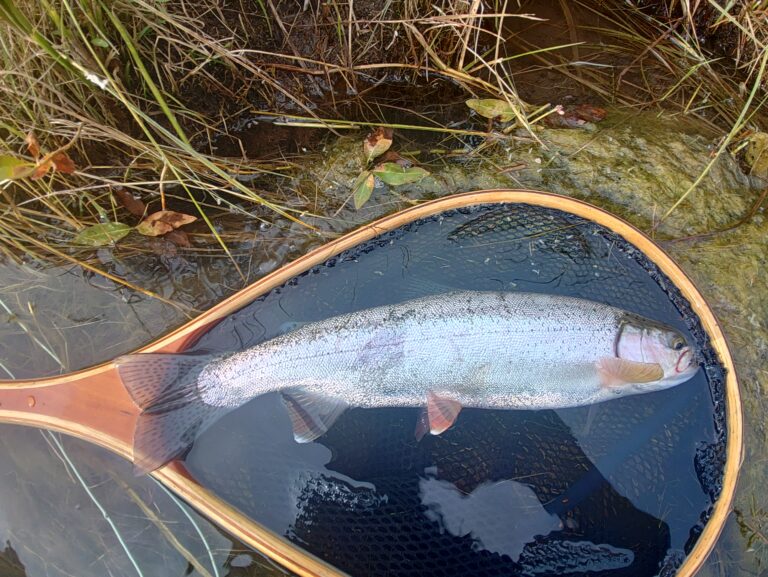
Nice Ranch fish caught on a small spent partridge caddis, September 21.
After “late summer” finally winds down, we now have a very long fall that lasts from early October through the end of December or even beyond.

Fall colors at the Fun Farm, October 18.
During my first extended fish-of-the-month streak back in the early 2000s, catching fish in December, January, and February was the most challenging; the summer months were easy. In recent years, high water temperatures, hot weather, low water supply, and poor water quality make the summer months more challenging, especially with my self-imposed gear constraints.

This wild rainbow hit the slumpbuster hard in mid-swing, November 11.
On the other hand, the endless fall season and warm winters make for great fishing with a trout spey rod and small streamers.

The only whitefish of the year, caught mid-swing, December 11.
Adapting to change is hard, and we have many challenges ahead to adapt infrastructure and ecosystems to provide quality fishing year in and year out in all river reaches. However, adaptation of my own individual angling practices and expectations has let the river reveal its resiliency, and I have learned a lot of new ways, times, and places to catch fish that you would think I would have already known after 48 years of fishing the Henry’s Fork. We’re never too old to learn.
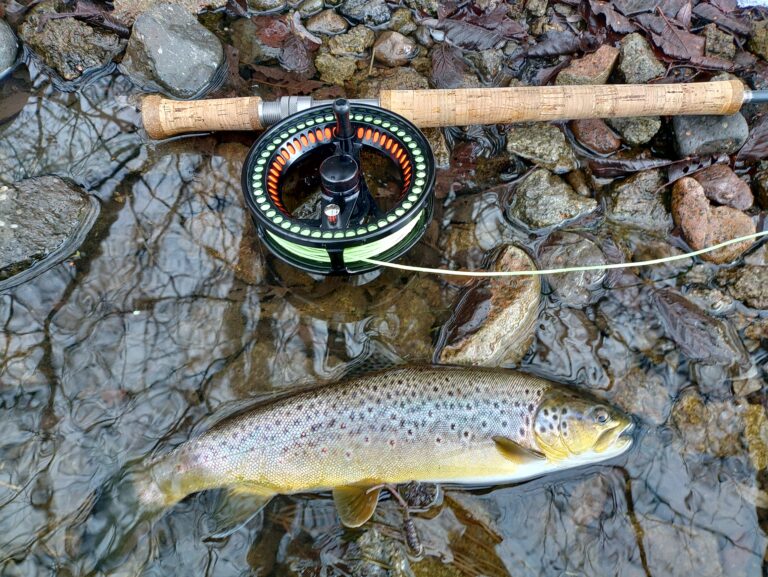
A fat brown trout caught a few casts after the whitefish, December 11.

And, a fat rainbow followed a few minutes later.
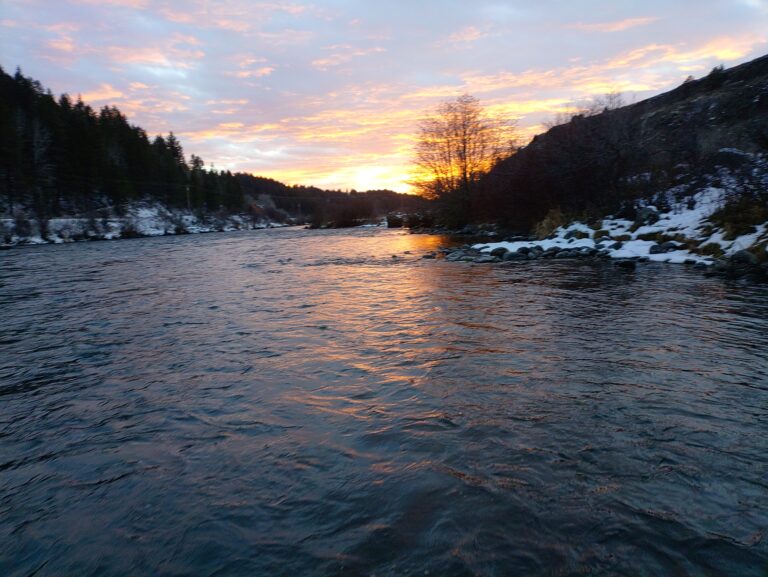
Last sunset of the year at Stone Bridge, December 20.