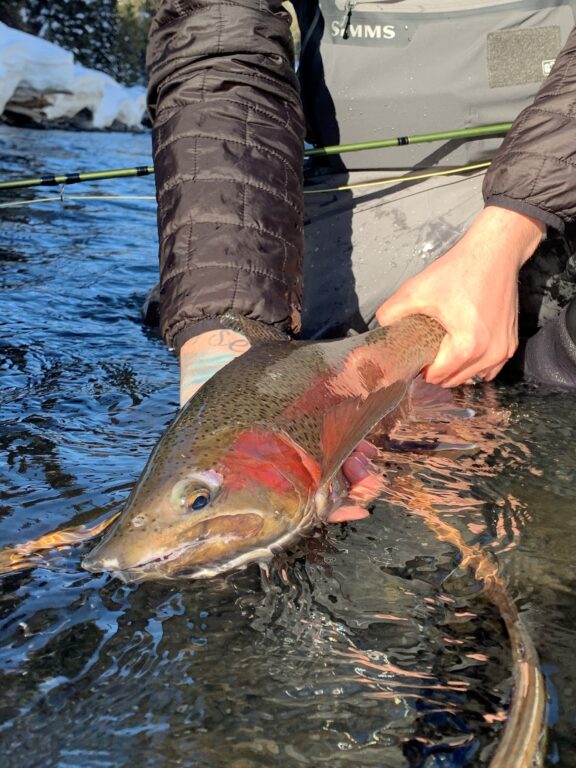
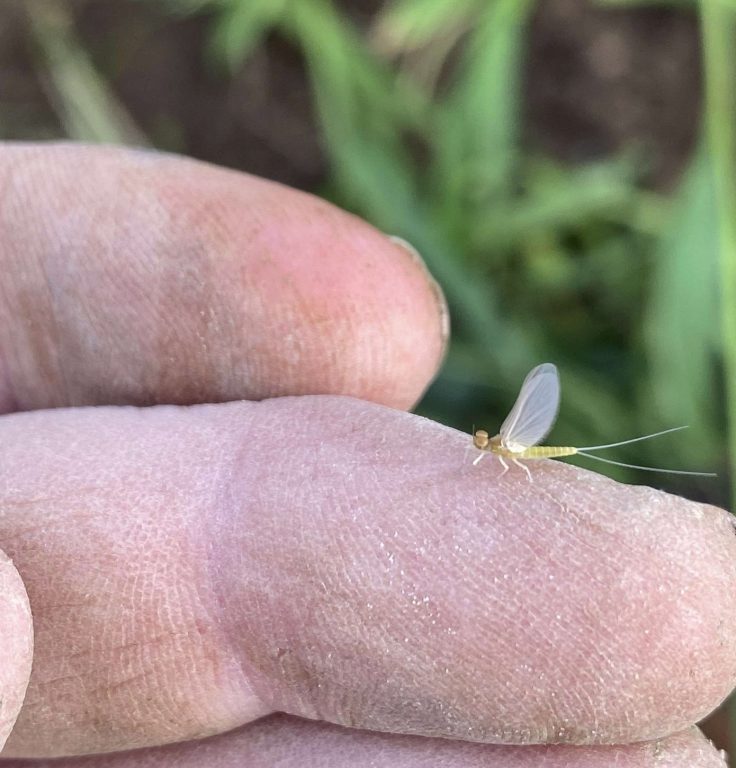
PMDs were one of the hot topics on the Henry’s Fork in 2024, so here’s a few excerpts from the 10 Year Insect Report just published, specifically about this insect.
Total numbers
Abundance of PMDs on the Henry’s Fork ranged from 365 individuals/m2 at St. Anthony in 2017 to 30,511 at Flat Rock in 2016, with an average of 7,701 individuals/m2 over all sites and years.
Another way of looking at PMD abundance is that it has ranged from 2% to 61% of the total invertebrate community, with an average of 21%. For reference, data from the Bighorn River show that PMDs are typically 4% or less of all individuals.
Change over time
PMD abundance has been systematically decreasing across the watershed for the past decade, driven primarily by a large decrease at Flat Rock and to a lesser degree by a modest decline at St. Anthony. Our data show no evidence of systematic trends in PMD abundance one way or the other at Last Chance, Osborne, or Marysville. We know that doesn’t necessarily reflect hatches experienced by anglers, but it is what the data is telling us. More on that below.

Insects Overall
By any measure, the aquatic invertebrate community up and down the river is abundant, diverse, and indicative of good to excellent water and habitat quality. Over half of the individuals are mayflies, stoneflies, and caddisflies, and that percentage has been improving over the past decade, along with the number of mayfly, stonefly, and caddisfly species present.
PMDs and Sediment
Data showed no evidence that suspended sediment was associated with lower numbers of PMDs on the Henry’s Fork or with decreased invertebrate community quality. Further, the HBI (an index of habitat quality) scores indicate little to no effects of organic pollution overall.
PMDs at Last Chance
No invertebrate trends are apparent in the data at Last Chance, including PMD abundance. Data show that average PMD abundance at Last Chance is lower than that at Flat Rock and Osborne, so it is possible that PMDs at Last Chance were formerly as abundant as they still are at those other two locations and declined substantially prior to the initiation of this study in 2015.
We are doing some digging into the data archives to see if we can find some comparable numbers for PMDs from the 1970s, 1980s and 1990s, but at least over the past 10 years, we have no evidence of decline in PMD hatches at Last Chance.
Certainly there is year-to-year variability, but oddly enough that variability in PMD abundance at Last Chance has not generally corresponded with angler experience. More on that in the next section.
Insect Numbers Vs Hatches
The four years in our study with the highest PMD abundance at Last Chance were:
1. 2017 (9,700 individuals/m2)
2. 2020 (7,700 individuals/m2)
3. 2018 (5,990 individuals/m2)
4. 2023 (5,950 individuals/m2).
…
9. 2024 (1,963 individuals/m2)
10. 2022 (1,744 individuals/m2)
Of these, by far the year with the best perceived hatches was 2020—and even most long-time anglers said that 2020 had the best hatches in decades, comparable to what was commonplace in the 1970s and 1980s. Yet, PMD abundance was quite a bit higher in 2017, a year that wasn’t bad fishing by most accounts but also wasn’t particularly noteworthy.
Based on angler comments, PMD hatches in 2024 were widely considered to be the worst ever at Last Chance and the upper Ranch, yet there were fewer PMDs in our samples in 2022, when we heard relatively little about poor hatches. Further, we generally heard the same negative comments about PMD hatches in 2023 as we heard in 2024, yet PMD abundance in 2023 was over three times what it was in 2024. All this is to say, we have more learn about why insect numbers and hatches aren’t lining up.
The Exception
Despite our observations that conditions over the whole watershed appear to be stable if not improving, Flat Rock is an exception. The watershed-scale decrease in PMDs on the Henry’s Fork is being driven primarily by a substantial decrease at Flat Rock.
These declines could be occurring because Flat Rock is the most pristine of our sites and hence has the most to lose as temperatures warm and drought increases. In other words, a couple of degrees of warming may not make that much of a difference at St. Anthony, where summertime water temperatures are already well into the 70s and have been for decades. But at Flat Rock, where temperatures have historically 15 stayed in the 50s and 60s all summer, a couple of degrees is proportionally a much greater increase.
Further, we know that the location in the Henry’s Fork watershed that has seen the greatest decrease in streamflow per unit of precipitation is the upper Henry’s Fork. While annual water supply over the whole watershed (including Fall River and Teton River) has decreased by 15% since 2000, water supply in the upper Henry’s Fork (above Island Park Dam) has decreased by 22%.

Honing in on Temperature
Our water-quality sonde data clearly show a trend toward increasing water temperatures over the past 10 years, and that trend applies over the whole watershed. Average summer water temperatures have increased by around 2 degrees F over the past 10 years.
While results do not indicate that invertebrate community structure or abundance of mayflies, stoneflies, and caddisflies are being negatively impacted by warming temperatures at the watershed scale, it is very likely that increased water temperatures are affecting the life cycle of the insects that are present.
Emergence and Water Temperature
It is well known that emergence behavior of aquatic insects is strongly determined by water temperature, and even small water temperature changes could result in large changes in emergence timing, both time of year and time of day.
As atmospheric temperatures warm, the difference between “warm” locations and locally “cool” locations will be greater than in the past, with hatches of specific insects being much more specific to location and time of day. The more localized a particular insect emergence is, the less likely it is that large numbers of the same insect will appear across large reaches of the river at the same time. This occurrence is exactly what produces the hatches for which the Henry’s Fork is famous.
So Why are Hatches, Especially PMDs, Changing in Last Chance?
- We know that outflow temperatures from Island Park Dam are cooler when the reservoir stays full.
- Water temperatures between Last Chance and Pinehaven are more resistant to warming from solar radiation and to cooling from the localized effects of cool groundwater inputs when outflow is high.
- Angling observations indicate that PMDs (and a few other mayflies) produce the most prolific hatches when water temperatures are relatively cool and relatively constant.*
*That is why spring creeks and large reservoir tailwaters are generally most well known for their PMD hatches.
In the Ranch, these conditions would occur when Island Park Reservoir stays full but outflow is high. The trouble is, over the past several decades, this condition is not physically possible, because high outflow leads to high reservoir drawdown, which leads to warmer outflow temperatures. Keeping the reservoir as full as possible requires low outflow, which is then susceptible to rapid warming once it hits Last Chance, especially because air temperatures are warmer now.
However, back in the 1970s, 1980s, and 1990s, reservoir inflows were so high (due to “big” water years, aka lots of water available) that it was possible to maintain high reservoir levels and high outflows at the same time. This would have produced a situation in which cool reservoir water remained cool all the way through the Ranch (not to mention the fact that air temperatures were lower), thus producing PMD hatches in large numbers at predictable times of year and times of day, all the way through the reach from Box Canyon to Pinehaven at the same time.
What is HFF doing about any of this?
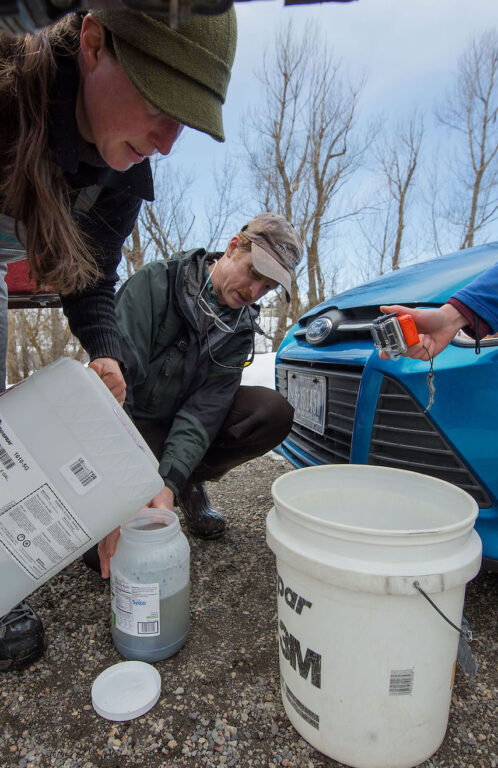
- With Idaho Department of Environmental Quality, complete a water temperature model for the river downstream of Island Park Dam so that we can assess how different weather conditions, reservoir management, and water supply affect water temperature in the Ranch
- Contingent upon funding availability, pursue infrastructure and habitat improvements in Island Park Reservoir and on the river downstream to decrease turbidity and water temperatures
- Develop and implement research in the future that will specifically investigate “hatches” as their own phenomenon, not necessarily reflective of the invertebrate community as a whole
- Continue the collaborative precision water management program that has saved over 20,000 acft of water per year in Island Park Reservoir, increased winter outflow by 100 cfs, and resulted in small but measurable improvements in summertime water quality downstream
- Continue to monitor invertebrates, water quality, and streamflow
- Scour our old hard-copy reports for invertebrate data collected prior to this study