What is the current climate like in the Henry’s Fork Watershed?
We have seen warmer temperatures and less water as a whole in water year 2025.
*2025 is currently tied with 2016 for the 4th warmest water year in the 37-year record and the 5th warmest spring and summer in that record.
*The total precipitation so far for water year 2025 is 15% less than average.
*Precipitation since April 1, 2025, is the 3rd lowest in the 37-year record.
*Natural streamflow is 30% less than average.
*Island Park Reservoir is 33% full, compared with 47% full on average.

What was turbidity like August-September 2025?
August Conditions
A turbidity event caused by multiple factors occurred in mid-August. Turbidity peaked at 21 turbidity units during this time.

September Conditions
Turbidity has recently (September 8) fallen back below 10 turbidity units — the lowest level in weeks. This welcome improvement is due to stable weather and reduced outflow, which have allowed sediments and algae to settle. While conditions are still slightly above the ideal turbidity level of 5 turbidity units for dry-fly fishing, it’s a notable step in the right direction.
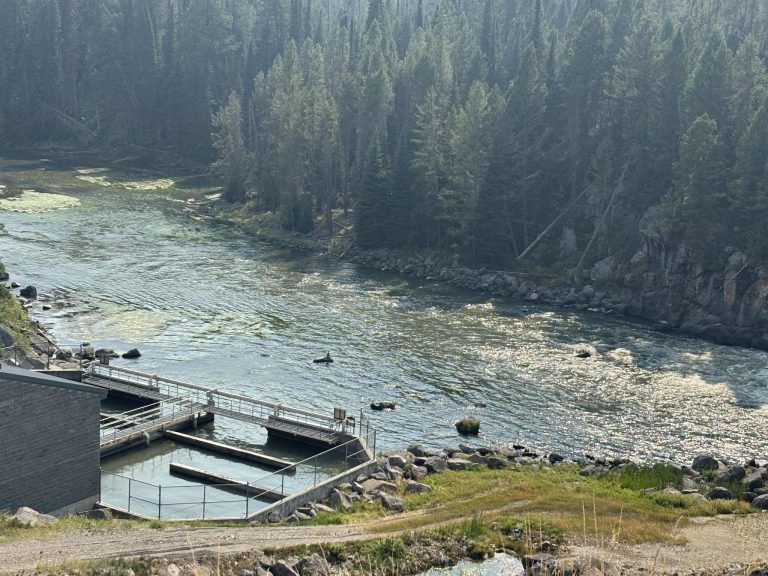
Where is the turbidity coming from?
The root of the issue remains complex.
Typically, the West End of Island Park Reservoir is where most sediment has originated from in the past. Our data, however, showed that most of the water that flows through the dam is originating in the main river channel with a high amount of algae being recorded. Through our data collection and weekly reservoir sampling, we have observed that this fall’s turbidity event is a result of several sources: decaying algae, minor amounts of sediment from the West End, recreation, and the need to release water through the dam gates instead of the power plant due to oxygenation equipment challenges.
Unfortunately, there’s no smoking gun and multiple sources will need to be addressed to achieve the lower turbidity levels desired.
Why can’t more water be passed through the power plant?
The power plant has dissolved oxygen requirements to meet under its operating license, and problems with its aeration system are preventing power plant outflow from meeting those requirements. While turbidity impacts the fishing experience, low oxygen levels can directly harm fish and aquatic insects. Fall River continues to work on repairs but dated infrastructure and the need for custom parts are slowing the process. However, Fall River is actively working on addressing the problem and will continue to look at long-term solutions.
What are the dissolved oxygen (DO) requirements for rainbow trout?
- Optimal: 8 mg/L or greater, depending on water temperature and fish life stage (warmer temperature = need for more oxygen, developing eggs/dry = need more oxygen)
- Lower end of suitable range: 5 mg/L
- Statewide standard to protect cold-water fish: 6 mg/L or greater
- Power plant requirements: 8 mg/L during April/May (spawning/rearing), 7 mg/L during March and May (spawning/rearing transition), 6 mg/L over the rest of the year.
- NOTE: The power plant previously had a constant requirement of 7 mg/L, advocated by HFF and set through the original Federal Energy Regulatory Commission license process in the 1980s. Stakeholders (Fall River Electric, IDEQ, HFF, IDFG and others) agreed to replace this constant requirement with the requirement above a few years ago to 1) provide more protection for sensitive eggs/fry and 2) make it easier for the power plant to meet the requirement during the summer, specifically for the purpose of decreasing turbidity in reservoir outflow.
Does the turbidity harm fish in addition to making for tough fishing?
We know that turbidity greatly diminishes the fishing experience, as it changes fish feeding behavior. Fish are less likely to rise, and it is harder to read the water, resulting in difficult fishing. Despite this, turbidity itself does not begin to negatively impact trout health until it exceeds 25 turbidity units. Turbidity does not have any potential for short-term negative effects on the survival of fish or aquatic insects at the levels we have observed in the Henry’s Fork over the past 10 years.
Drops in dissolved oxygen, on the other hand, can quickly kill fish and aquatic insects. Fish are unable to detect drops in oxygen and do not have places to seek refuge from these drops, even if they could detect these changes. Our sondes (water quality monitoring devices) have not detected any dissolved oxygen concentrations this summer that would be in the stressful threshold throughout this recent turbidity event (or all summer).
The greatest negative effect of above-average turbidity (5-25 turbidity units) in the Henry’s Fork is change in surface feeding behavior of trout, which makes it more difficult to fish for them, especially with dry flies; but does not yet effect overall feeding success as they have plenty to eat at the bottom of the river, even at 10-25 turbidity units.
Why is turbidity higher when flow comes out of the gates?
- There are two dam outflow points:
- 1) original dam gates
- 2) power plant siphon
- The dam gates were built when the dam was built in the 1930s and sit in the old river channel at the very lowest point in the reservoir.
- The power plant was added to the dam in the 1990s, and the siphon is located in a bay off of the old river channel and draws water from about 20 feet up off the bottom of the reservoir.
What is HFF doing about turbidity?
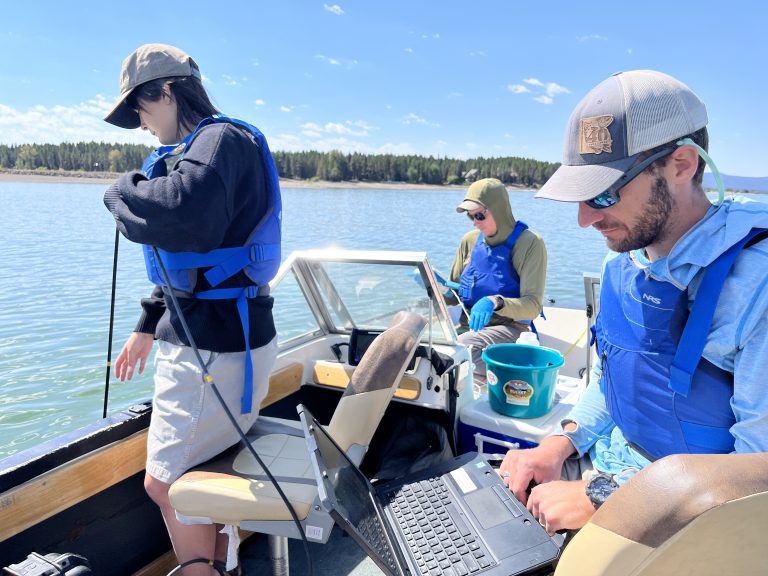
Our field crew takes measurements at Island Park Reservoir weekly. We also monitor the conditions in the river and on the reservoir daily with our water quality monitoring network of sondes. This year we even rolled out a new Island Park Reservoir data website where you can view the data here: https://henrysforkdata.shinyapps.io/IPRData/
Getting back to ideal conditions – under 5 turbidity units for optimal fishing – will require a broader, long-term approach that includes addressing algae blooms before they start and implementing infrastructure that allows more selective water releases with lower turbidity levels. The good news is that all of this is a part of HFF’s new DIRTT plan! The DIRTT plan is a multi-million dollar, long-term project that will address temperatures and turbidity in the reservoir and downstream.
Dr. Jack McLaren has worked all summer with engineering consultants to determine what types of infrastructure can be implemented on the reservoir to help with turbidity. Jack’s idea of installing a variable-elevation withdrawal structure that will provide the capability to deliver less turbid water into the river downstream, even when conditions in the reservoir are bad. Jack is essentially spending all of his time on the DIRTT plan currently and will be for the next few years.
Learn more: https://henrysfork.org/post/frequently-asked-questions-turbidity-in-island-park-reservoir-outflow/