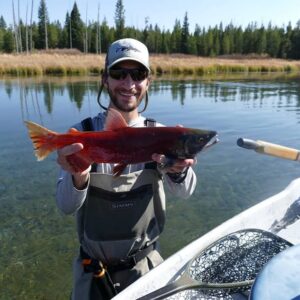
In a first-of-its-kind adaptive science effort for the Henry’s Fork, the Idaho Department of Fish and Game (IDFG) and Henry’s Fork Foundation (HFF) are launching a pilot project this October to evaluate whether small-scale relocation of wild Rainbow Trout can strengthen long-term fishery resilience. On the South Fork, a small number of Rainbow Trout are being relocated as part of IDFG efforts to suppress Rainbow Trout abundance by 30% to benefit native Yellowstone Cutthroat Trout conservation. Approximately 400 of these wild Rainbows will be transferred under IDFG supervision as one experimental component of a broader, data-driven management strategy.
The relocation will take place in mid-October. These are not hatchery fish, but wild trout that will be carefully marked to support long-term monitoring and help estimate their contribution to the population during routine assessments, including the spring 2026 Box Canyon population survey.
“This is an opportunity to provide a win-win management action for both the South Fork and Henrys Fork fisheries,” said Brett High IDFG Regional Fisheries Manager. “IDFG was already planning on moving these valuable wild Rainbows from the South Fork Snake River to a different location that could be improved with the addition of more trout. The section of the Henrys Fork receiving these Rainbows is the most appropriate place because juvenile Rainbow Trout are not surviving well with low winter flows during drought years. The older Rainbows from the South Fork should survive the winter well in the Henrys Fork and provide an immediate benefit to anglers, a win for the Henrys Fork fishery while providing conservation benefits for Cutthroat Trout in the South Fork, a win for the fishery there.”
The project builds on prior success where IDFG translocated Rainbow Trout from the South Fork Snake River to Idaho’s Big Lost River in 2022 and 2023. The project is also guided by a robust monitoring plan. Results will be transparently reported and used to inform future decisions.
“Monitoring is the most important part of this effort,” said HFF Senior Scientist Dr. Rob Van Kirk. “This is an experimental project, and we want to see if it truly makes a difference. Because we know the dynamics of this river system so well, we’re in a strong position to understand the impact of these fish on the overall population.”
While the pilot is new to the Henry’s Fork, it reflects a growing need for adaptive fisheries management across the West. Conservation leaders are increasingly using thoughtful, data-driven approaches to address the challenges presented by shifting river conditions
“Translocating wild South Fork Rainbows to the Henry’s Fork is an exciting opportunity and an elegant response to the respective challenges facing each river. Contributing a small but measurable bolster to the Henry’s Fork wild Rainbow Trout fishery will hopefully support and strengthen angling opportunities,” said Scott Yates, career professional in Western water and fish conservation. “But most importantly, this pilot program allows IDFG, HFF, and other stakeholders to monitor the response of the fishery while at the same time continuing crucial partnership work and science-driven data collection to address long-term drought and water quality issues facing the Henry’s Fork watershed.”
Local anglers have long been invested in the health of both rivers, and many see this pilot effort as a practical way to strengthen the fishery without relying on hatchery intervention. Those who know these waters recognize that South Fork and Henry’s Fork Rainbows share a strong genetic foundation and perform exceptionally well in both systems.
“I’ve fished both rivers all my life and I am a licensed outfitter on both rivers today,” said Mike Lawson, founder of Henry’s Fork Anglers. “Stocking hatchery Rainbow Trout at Last Chance continued when we opened our shop in 1977. I recall three different occasions when all of the trout in the reservoir were eliminated and then re-stocked by the IDFG. I am confident that the genetics of Rainbow Trout in the South Fork and Henry’s Fork are very compatible. One reason anglers are reluctant to kill Rainbow Trout in the South Fork is because they are in great condition and they fight hard. I believe Rainbows from South Fork will enhance the quality and quantity of the fishery in the Ranch. It is a win/win project.”
About the Partners:
The Henry’s Fork Foundation (HFF) is a nonprofit organization dedicated to conserving the world-class wild trout fisheries of the Henry’s Fork of the Snake River and connected watersheds through science-based collaboration.
The Idaho Department of Fish and Game (IDFG) preserves, protects, perpetuates, and manages all of Idaho’s fish and wildlife and fisheries resources using science, public involvement, and statutory responsibility.
For more information, visit www.henrysfork.org or idfg.idaho.gov.