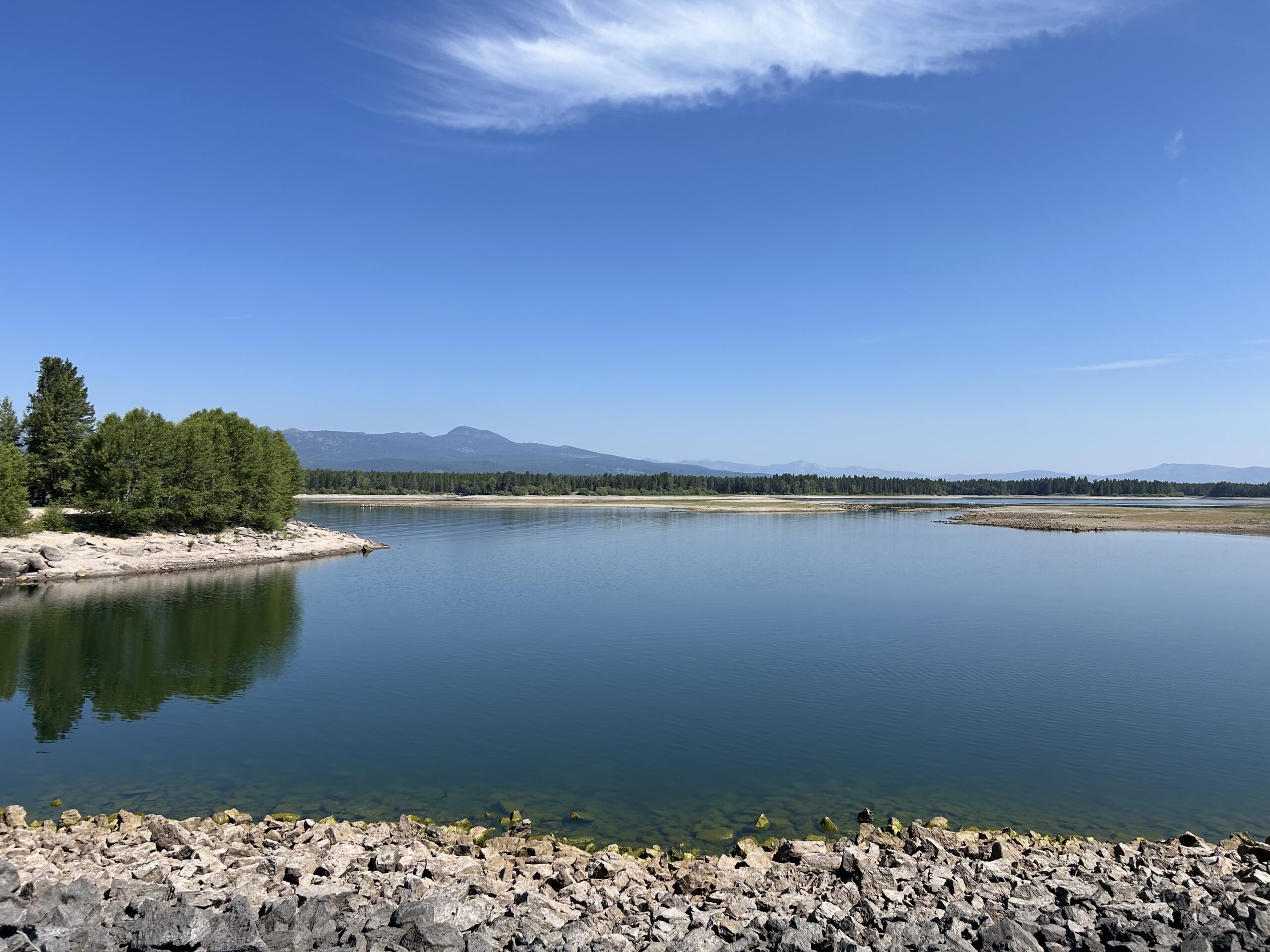
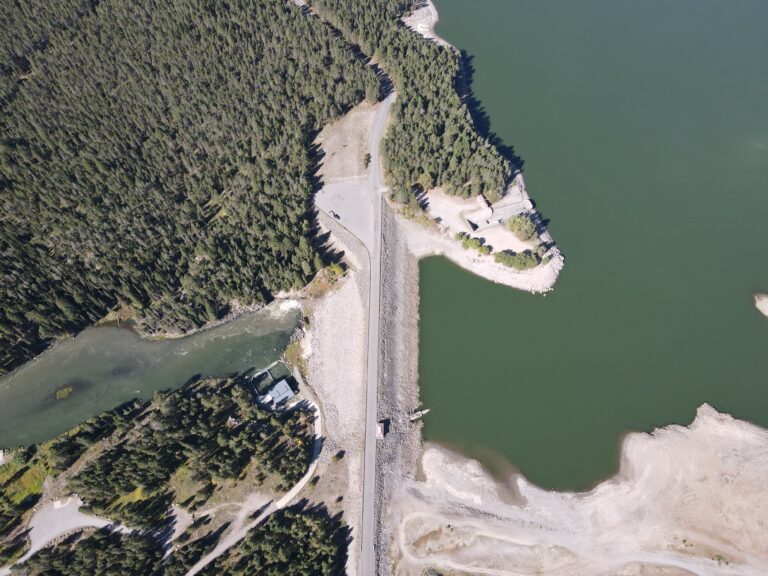
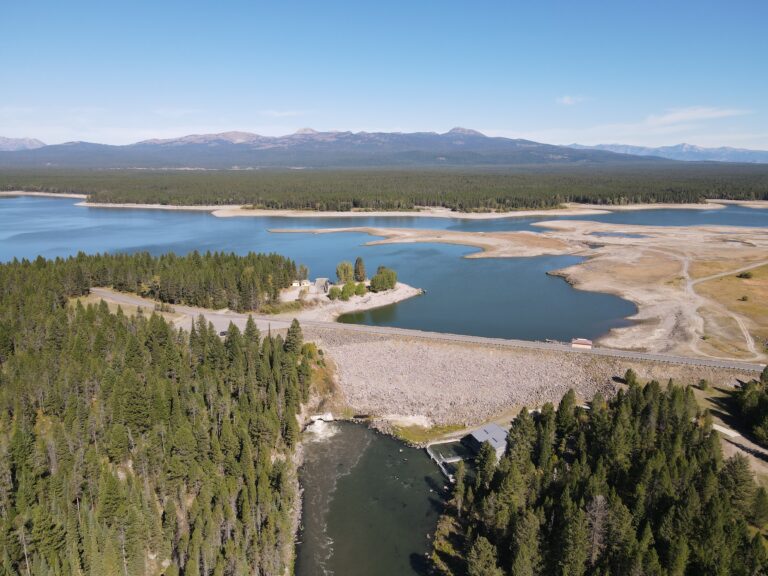
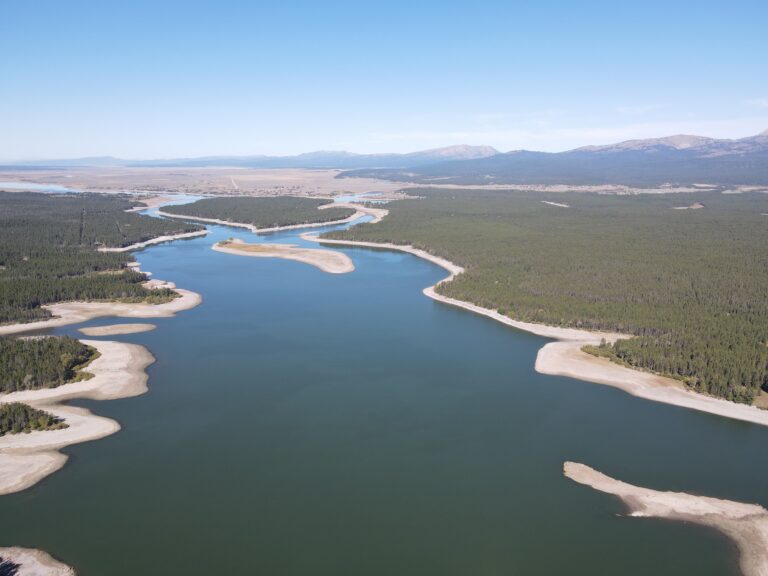
Photo of Island Park Reservoir, taken July 31 2026
Summer 2026 is the Henry’s Fork Foundation’s 11th summer monitoring conditions in Island Park Reservoir, and we continue to learn something new even a decade later. This summer’s lesson? How rain and high outflow disrupt algae blooms—maintaining clear water, for longer.
The Weather Event
At the end of June, data from HFF’s weekly monitoring on Island Park Reservoir showed that algae growth was creeping up and water clarity was crawling down. Without some wet weather, we expected warm water and low water clarity flowing out of the reservoir as early as July 4th. But then it rained. June 25–July 2 brought heavy rain and cool temperatures. Rain falling directly on the reservoir created a thick surface layer of cold water. This new cold layer sunk down and caused the reservoir to mix and turnover. In fact, the late June rain event cooled the entire reservoir by a whopping 6°F. After a cold-cycle tumble wash, the reservoir’s summer slate was wiped clean.
The July Story
We started over with a cool, clear reservoir on July 3. Then, only nine days later, irrigation demand peaked. Outflow from Island Park Reservoir skyrocketed to 1,500 cfs on July 12 and lasted for ten days. Such high outflow wholly exhausted the brand-new deep pool of cool water near the dam. On July 27, HFF recorded water temperature of 69°F flowing out of Island Park Dam—an all-time record high. Although warm water from the reservoir limits angling opportunities on the Henry’s Fork downstream, it does benefit water clarity. Cool, low oxygen conditions at the bottom of the reservoir release nutrients that fuel algae blooms. But with zero cool water left and oxygen levels better than usual, nutrients are staying put and the green algae responsible for turbid water downstream is nearly absent.
Thus, it is unlikely the poor water clarity conditions HFF previously predicted will be realized this season, at least for any extended period. And that is something to celebrate.
Let’s Chat Algae
But green algae and cyanobacteria (“blue-green algae”) are different. Cyanobacteria, although it does not degrade downstream water clarity as much as heavy algae blooms, it does create harmful algal blooms (HABs) that are a public health risk for reservoir recreationists. On July 24, state agencies confirmed the presence of toxic cyanobacteria in Island Park Reservoir and issued a health alert. For HAB recreation advisories, please visit the Idaho Dept. of Environmental Quality website: https://www.deq.idaho.gov/water-quality/surface-water/cyanobacteria-harmful-algal-blooms/.
Forecast for August
Beyond water quality, water levels in Island Park Reservoir are near-record lows. Island Park Reservoir is currently 41% full and will be likely 30–35% full by August 20. As a result, reservoir recreationists should continue to expect low reservoir levels, more boating hazards, and fewer accessible boat ramps. Once the reservoir reaches 25% full, the powerplant at Island Park Dam will no longer be able to operate and turbidity levels downstream may increase as outflow to Box Canyon will originate from the dam gates.
Resources
For water quality resources for the river and reservoir, please visit henrysfork.org/river-conditions and send questions to hff@henrysfork.org.
In the future, we hope to not have to rely on luck or rain for good water quality. Learn more about HFF’s plan to mitigate algae cycles and preserve cool water in Island Park Reservoir by visiting henrysfork.org/dirtt-plan.