A New Way to Visualize Water Clarity

Home » Blog » A New Way to Visualize Water Clarity
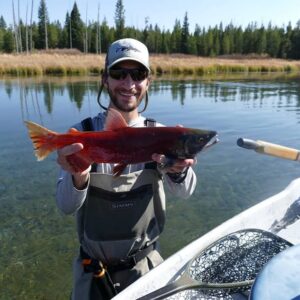
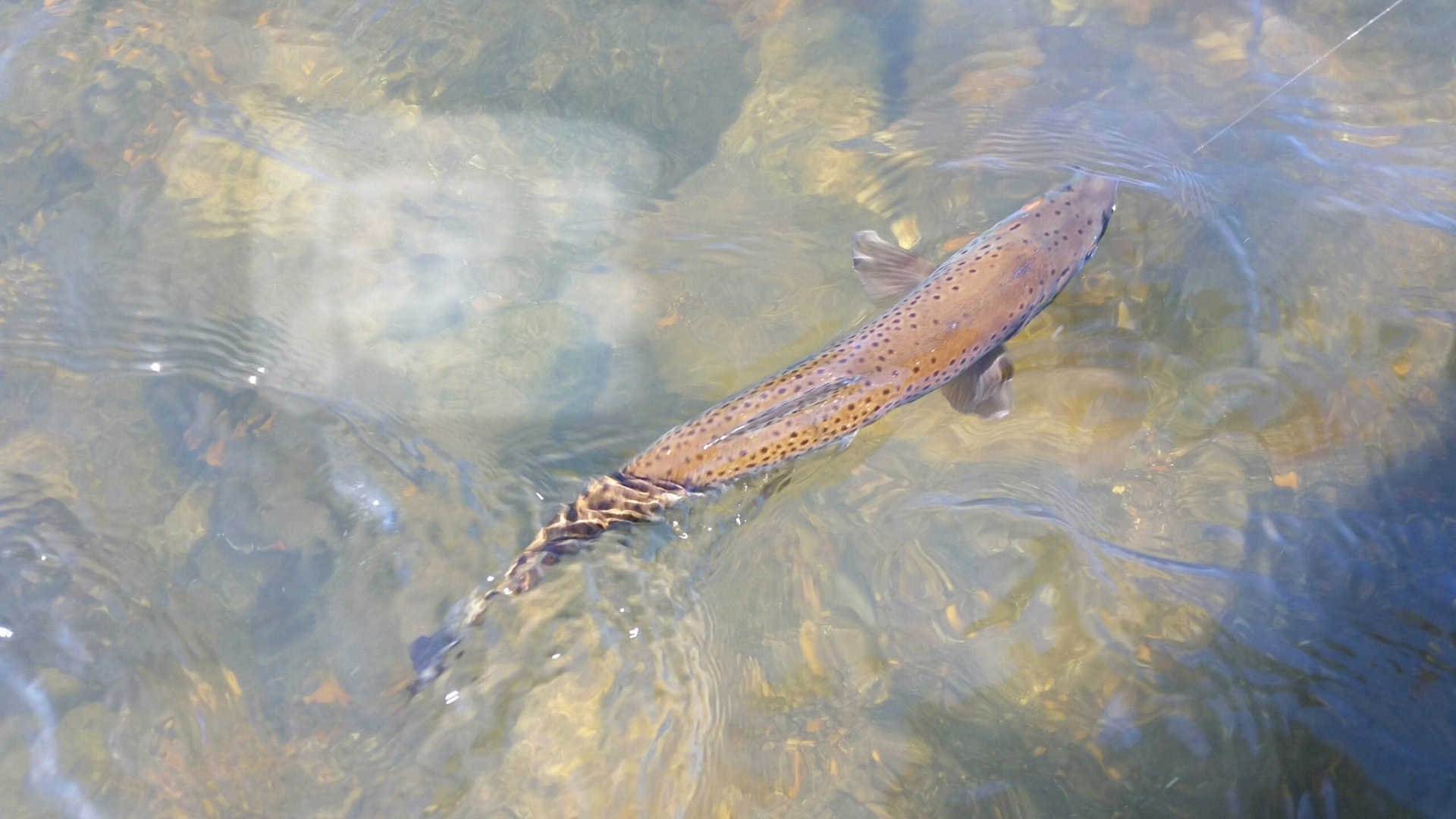
rainbow trout caught on a fishing line

As we walk down to the river bank, fly rod in hand, we read the water. We think about safety and success as we consider how fast the river is flowing and where the deep spots might be. We look for bugs coming off the water, feeding lanes, and rising snouts. We also note the color and clarity of the water (what scientists call turbidity) as we ponder river health and what fly we should use to make that first cast.

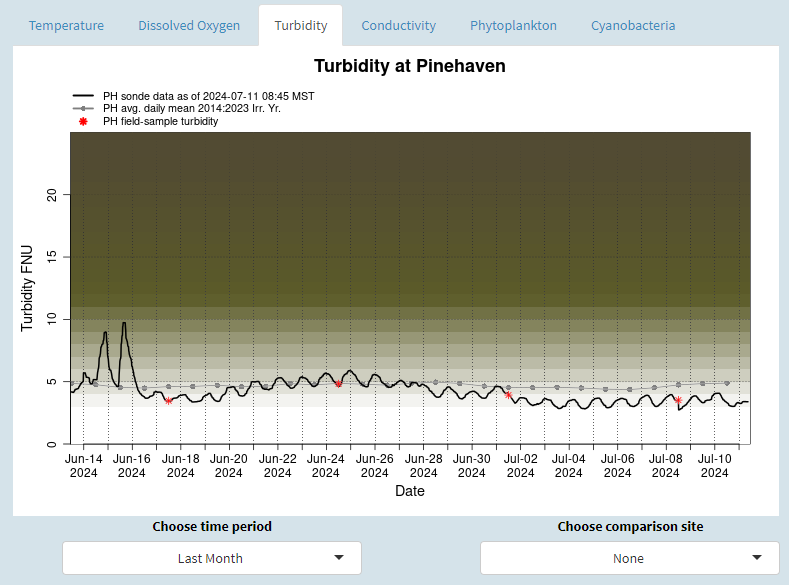
The Henry’s Fork is a relatively clear river compared to other trout streams. HFF water quality monitoring equipment installed throughout the watershed typically measure turbidity between 0.05 and 10 Formazine Nephelometric Units (FNU). But what does that actually mean, in practice? Turbidity units are weird, we know. That’s why we’re launching a brand new way to visualize turbidity/water clarity on the Henry’s Fork—so anglers can better prepare for their fishing day and better contextualize how today’s water clarity compares to what happened yesterday, last week, last month, last year, or whenever they were last on the Henry’s Fork (within the last 10 years).

How brown is the river?

A screenshot of HFF's water quality web app displaying a turbidity graph for a site. The background gets progressively more brown as turbidity increases.Turbidity at Pinehaven from June 13 to July 11, 2024
HFF’s real-time water quality website (https://henrysforkdata.shinyapps.io/scientific_website/) was launched in 2017. The original website provides context for optimal, stressful, and lethal temperatures and dissolved oxygen conditions along the river. We are now bringing that same approach to our turbidity tab. Few folks know what a Formazine Nephelometric Unit means, and even fewer can pronounce it correctly on their first try. That’s why we have added context to our turbidity/water clarity data so users can have a sense of how “brown” the river might be for a given turbidity level at different locations across the watershed.

Users can also:

  • Choose a time period (last week, last month, last year, etc.) and even choose a custom date range
  • Choose a site for comparison (out of the 14 sites available)
  • Download 15-minute data
  • Download daily mean data

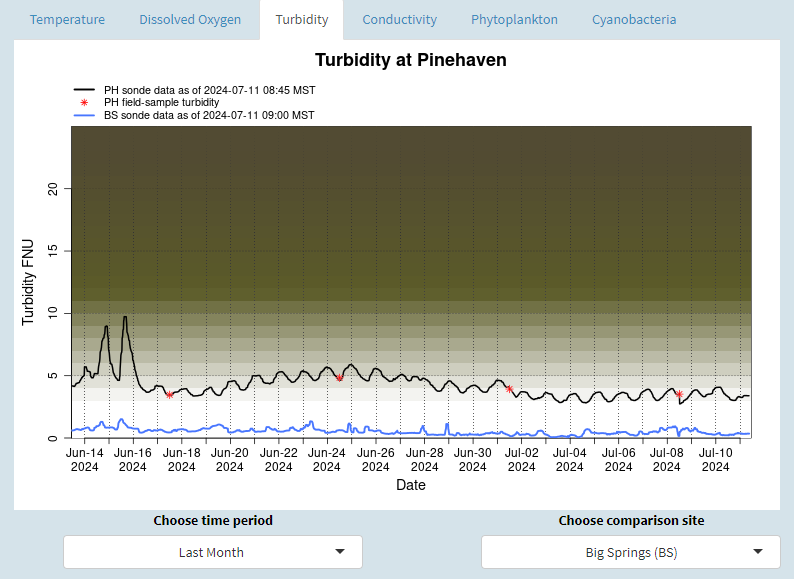
A screenshot of HFF's water quality web app displaying a turbidity graph for a site. The background gets progressively more brown as turbidity increases. A black line sits between 4 and 10 FNU for Pinehaven. A blue line sits between 0 and 1 FNU for Big Springs.Comparison of turbidity/water clarity at Pinehaven (in black) with Big Springs (in blue) for June 13-July 11, 2024.
The comparison feature allows you to visualize water clarity at two sites in the same graphic. In the example above, we compare turbidity at Pinehaven vs. Big Springs. As expected, water coming out of Big Springs is crystal clear and just barely above 0 with no brown shades in the background. Pinehaven, located near the bottom of the Ranch and ~15 miles downstream of Island Park Dam, has picked up more shades of brown (but is still relatively clear). Do you see the spikes in turbidity around June 14? Those were due to wind churning up sediment near the river bank. HFF’s very own Rob Van Kirk noticed this after fishing the Ranch Opener on June 15.


How we related turbidity units to shades of brown

Water quality monitoring sondes record turbidity every 15-minutes and the HFF field crew takes a manual water sample to test turbidity back at the lab each week. This helps us keep our instruments calibrated and in working order. We take additional water samples during major events, like a managed spring freshet, and typically pair it with a picture for a visual reference.

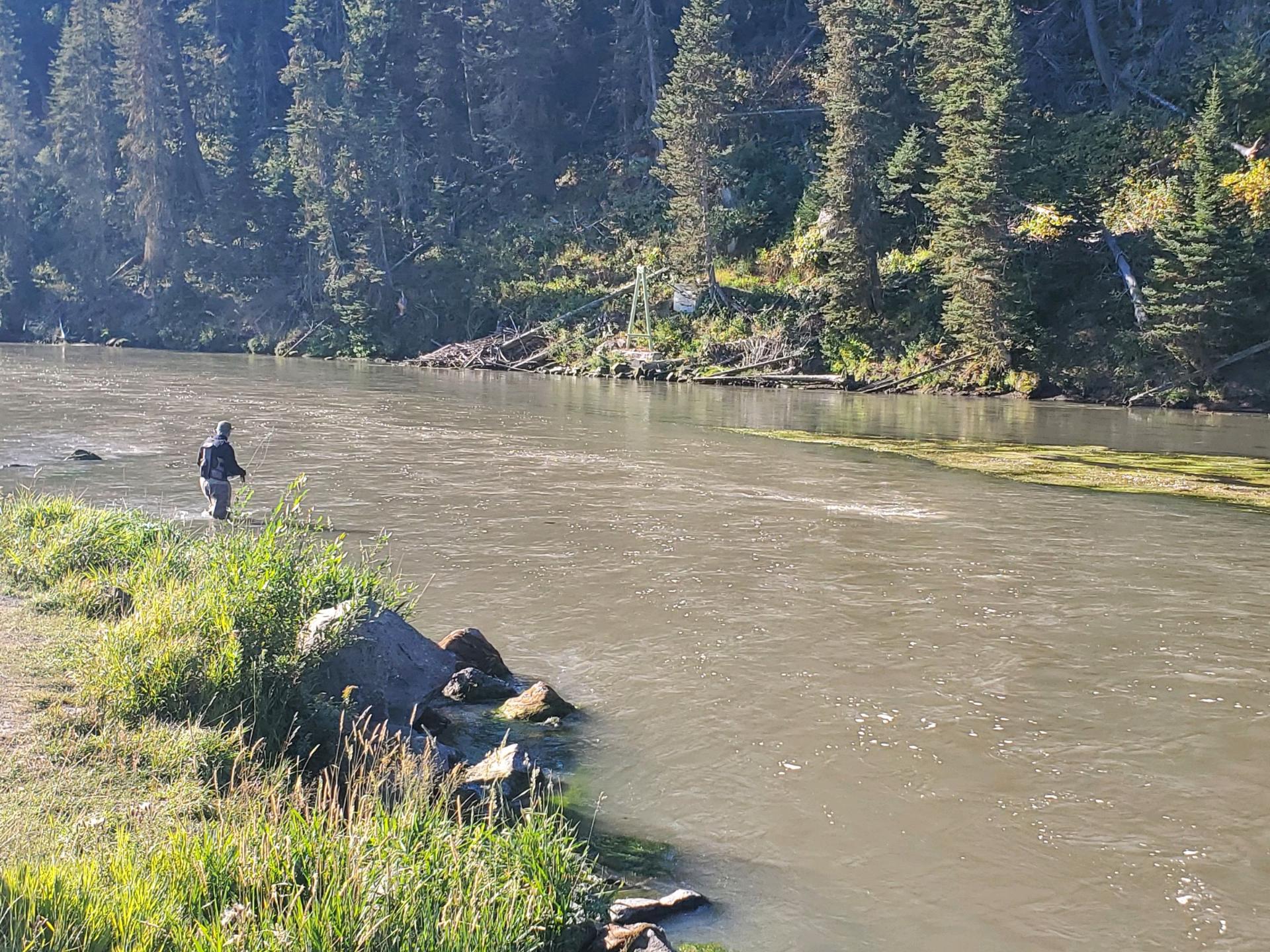
~20 FNU in Box Canyon ~80 FNU at Pinehaven

#pro-gallery-qmwhz72504 .gallery-item-container { opacity: 0 }
#pro-gallery-qmwhz72504 .gallery-item-hover::before { background: transparent !important}

try { window.requestAnimationFrame(function() { var ele = document.getElementById(‘pro-gallery-qmwhz72504’); var pgMeasures = ele.getBoundingClientRect(); var options = (() => “gallerySizeType:px|enableInfiniteScroll:true|titlePlacement:SHOW_ON_HOVER|gridStyle:1|imageMargin:5|galleryLayout:2|isVertical:true|numberOfImagesPerRow:2|cubeRatio:1|cubeType:fill|galleryThumbnailsAlignment:none”)(ele); var width = pgMeasures.width; var height = pgMeasures.height; var isIOS = /iPad|iPhone|iPod/.test(navigator?.userAgent); if(isIOS) { width = width; width = width; height = height; height = height; } else { width = width; width = width; height = height; height = height; } pgMeasures = { top: pgMeasures.top, width, height }; var isVertical = options.includes(‘layoutParams_structure_scrollDirection:”VERTICAL”‘); var layoutFixerUrl = ‘/_serverless/pro-gallery-css-v4-server/layoutCss?ver=2&id=qmwhz72504&items=3578_1920_1440|3620_540_960&container=’ + pgMeasures.top + ‘_’ + pgMeasures.width + ‘_’ + pgMeasures.height + ‘_’ + window.innerHeight + ‘&options=’ + options; document.getElementById(‘layout-fixer-style-qmwhz72504’).setAttribute(‘href’, encodeURI(layoutFixerUrl)); }); } catch (e) { console.warn(‘Cannot set layoutFixer css’, e); }

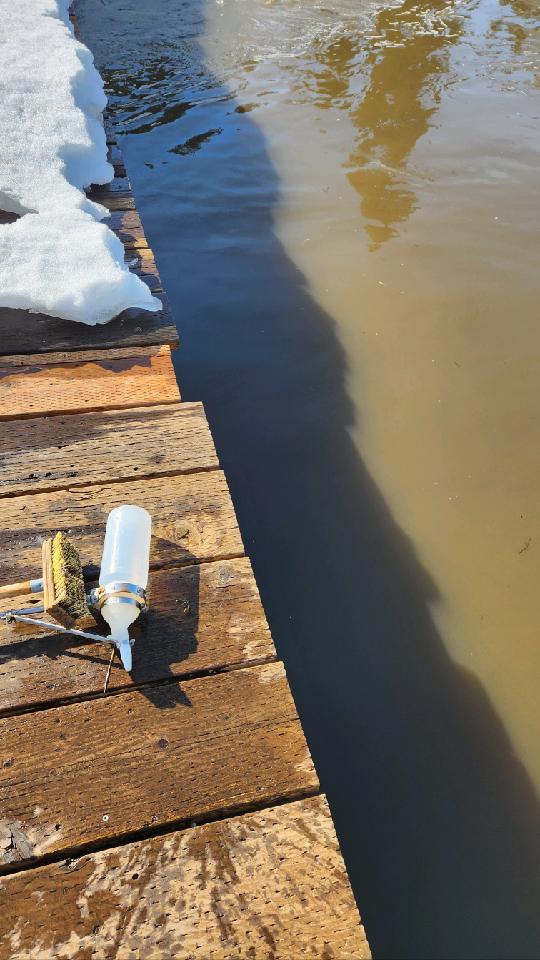
For example, these two images are from major turbidity/water clarity events in the river. Picture 1 (with the person in the river) was taken at the Box Canyon boat ramp downstream of Island Park Dam on September 7, 2020 after a major windstorm cooled down the water’s surface on the west end of Island Park Reservoir and created a density current that moved water with a lot of suspended material downstream. We measured ~20 FNU at this location. More info about this event available at https://henrysfork.org/post/sediment-transport-in-2020-what-caused-the-september-event. Picture 2 (with the dock) was taken at Pinehaven during the Spring 2023 freshet. We measured ~80 FNU at this location. We color-matched these two photos to anchor our visualization for the web app.

We also considered the difference in color when water clarity issues arise from productivity events versus mineral-sediment events. The two photos above were taken during sediment events and depict more than 15 FNU. Sediment events make the Henry’s Fork a brown hue that is not necessarily darker, but far less transparent. We tried to capture this dynamic by making the gridlines more obscure near the highest values. Turbidities associated with productivity events are usually in the 5-10 FNU range and give the river a more greenish tint, but maintain the river’s transparency (or see-through quality).

Want more information?

If you want to learn more about water clarity in the Henry’s Fork—what turbidity is, why it might change throughout the year, and what solutions HFF is pursuing to improve water clarity year-round, visit our StoryMap (https://storymaps.arcgis.com/stories/4e525b8dac894c699e302c190f828af1#ref-n-l9SHwr).

Have questions?

Our turbidity data can be wonky sometimes. If you use our turbidity tool and are confused, concerned, or curious about certain measurements, please contact us at hff@henrysfork.org or give the office a call at 208-652-3567. Our science team is happy to answer your questions!

Facebook
LinkedIn
Pinterest

Recent Posts

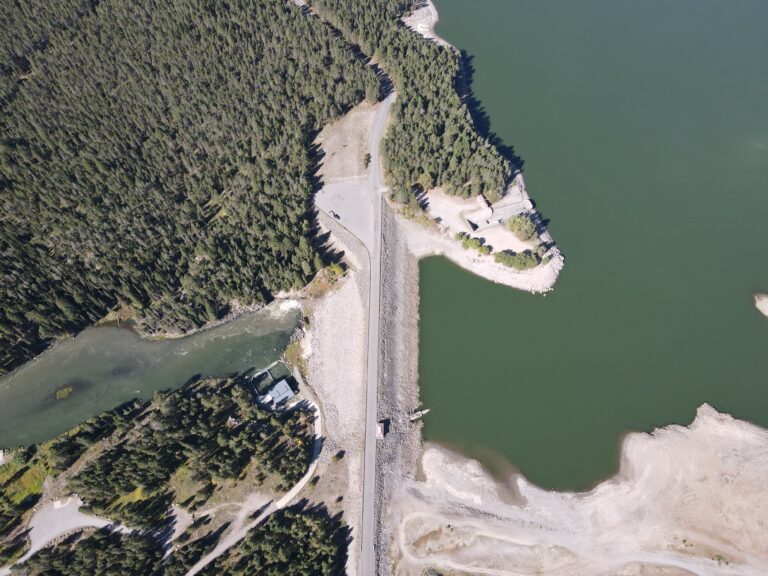
An aerial view of Island Park Dam. The reservoir sits behind it and the river flows below it.
Water Quality
Christina Morrisett

Summer 2026 Water Quality Forecast for Island Park

This article was originally published in Island Park News on May 29, 2026 Ice melted on Island Park Reservoir on March 31, 2026—four weeks earlier than normal and the earliest the Henry’s Fork Foundation (HFF) has observed in 12 years of monitoring. Such an early ice melt was not unexpected given the region’s near-record warm and dry winter. But ice melting a month early has implications for water quality in Island Park Reservoir and the

Read More »
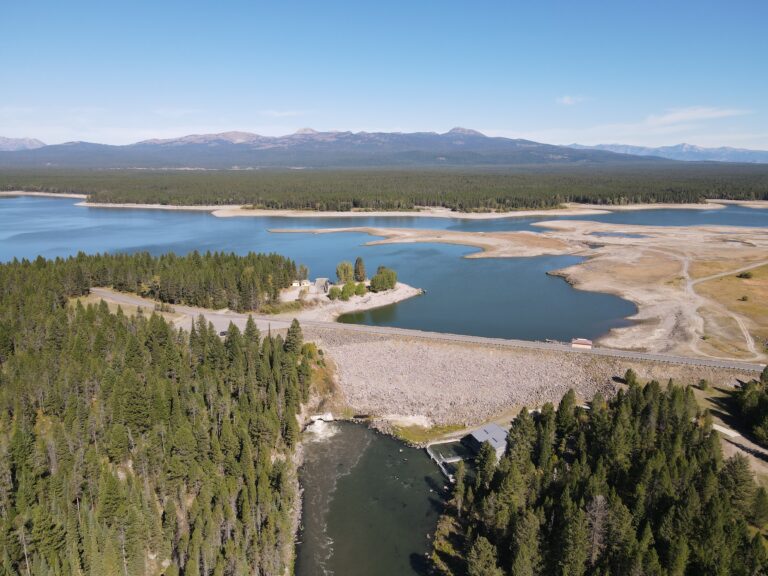
Aerial photo of Island Park Reservoir. The dam is in the bottom left corner. The Centennial Mountain Range is in the top.
Research and Monitoring
Christina Morrisett

History of Water Quality in Island Park Reservoir

Warmer and drier conditions have slowly degraded water quality in Island Park Reservoir over the last 50 years.  In the 1970s and 1980s, federal reports and university research indicate that the reservoir had relatively good water quality. Island Park Reservoir was mesotrophic—with mostly clear water and occasionally low dissolved oxygen at the reservoir’s deepest depths during the summertime. But, as time went on, water quality began to decline. Historical satellite imagery analyzed by the U.S.

Read More »
A photo taken of Island Park Reservoir while standing on the dam and looking north. The sky is cloudy, Mt Sawtelle sits with little snow in the background, and the reservoir is open water (save for a few small sheets of ice in the distance).
Frequently Asked Questions
Christina Morrisett

Reservoir Ices Off, Growing Season Turns On

Photo of an ice-free Island Park Reservoir taken on March 31, 2026 On March 31, 2026, with no accompanying commentary, HFF scientist Christina Morrisett stood on top of Island Park Dam and texted colleagues Rob Van Kirk and Jack McLaren photos of open water on Island Park Reservoir. Rob, eager to see that the reservoir reality matched what he was seeing in the real-time river data downstream, texted back, “Yep! That’s close enough to ice

Read More »
Photo of confluence of Warm River and Henry's Fork
Fishing
Rob Van Kirk

Water Supply and Water Quality Predictions for Summer 2026

The photo above captures the unprecedented situation we face at the beginning of April. The photo, of the confluence of Warm River and the Henry’s Fork, was taken on February 7 and shows the shocking lack of snow we experienced in the watershed all winter as a result of record-breaking warm temperatures. How will the warm winter and lack of snow affect water supply, water quantity, and fisheries? The highlights are below. If you want

Read More »