This time of year, one question is top of mind: what can we expect from the summer fishing season on the Henry’s Fork?
Every spring since 2017 I have used a set of computer models to predict water supply, irrigation-system management, water quality, and fishing conditions for the upcoming April–September period. The predictions are intended to provide outfitters and guides, anglers, water managers, water users, and other river stakeholders with an objective set of information that will help them set realistic expectations for the upcoming season. For water managers in particular, the predictions are intended to help fill water rights, meet system-wide objectives, and optimize reservoir carryover as efficiently and precisely as possible. This year’s predictions are presented in three sections: water supply, irrigation-system and reservoir management, and water quality/fishing experience.
Here are the key points. If you want the full report, with all tables and graphics, you can view that here.
Water Supply
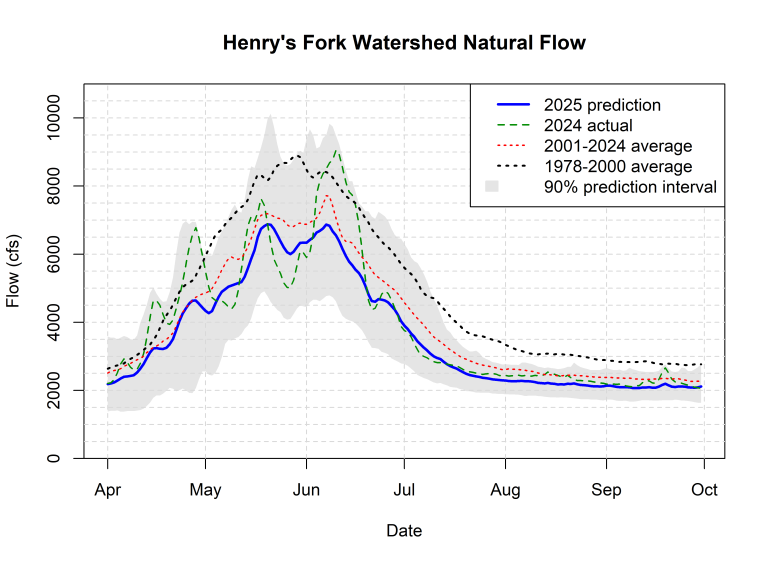
Natural streamflow over the period April 1—September 30 is predicted to be 91% of the 2001–2024 average: 83% in the upper Henry’s Fork subwatershed, 95% in Fall River, and 94% in Teton River. For comparison, last year’s April–September natural flow was 92% in upper Henry’s Fork, 92% in Fall River, and 114% in Teton River. When compared with the historic 1978–2000 period, this year’s expected water supply is substantially lower: 75% of the historic average for the watershed and 65%, 80%, and 82% of that average for upper Henry’s Fork, Fall River, and Teton River, respectively. Timing of natural flow, as measured by the hydrograph center of mass, is expected to continue the long-term trends of occurring earlier in snowmelt-dominated subwatersheds and later in the groundwater-dominated subwatersheds. Models predict that center of mass in 2025 will be two days earlier than the 2001–2024 average in Fall River and Teton River and within a day or two of last year. Center of mass in the upper Henry’s Fork subwatershed is predicted to be one day later than the 2001–2024 average and two days earlier than last year.
Irrigation and Reservoir Management
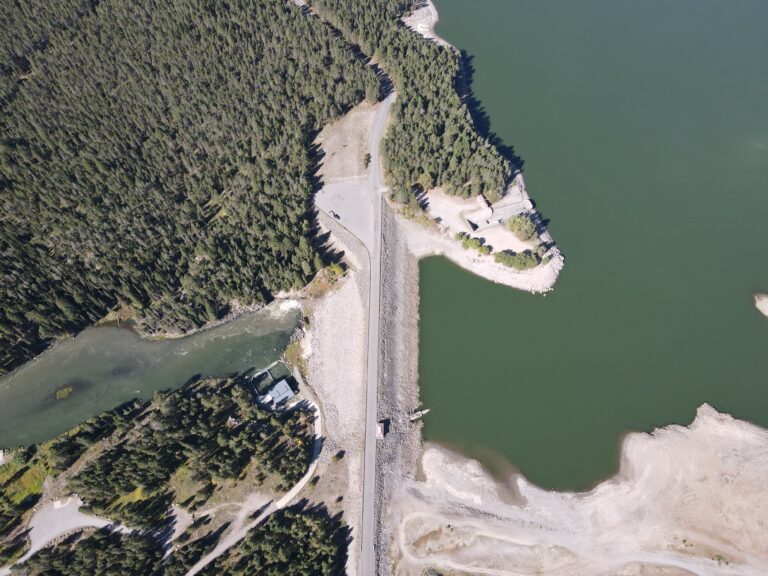
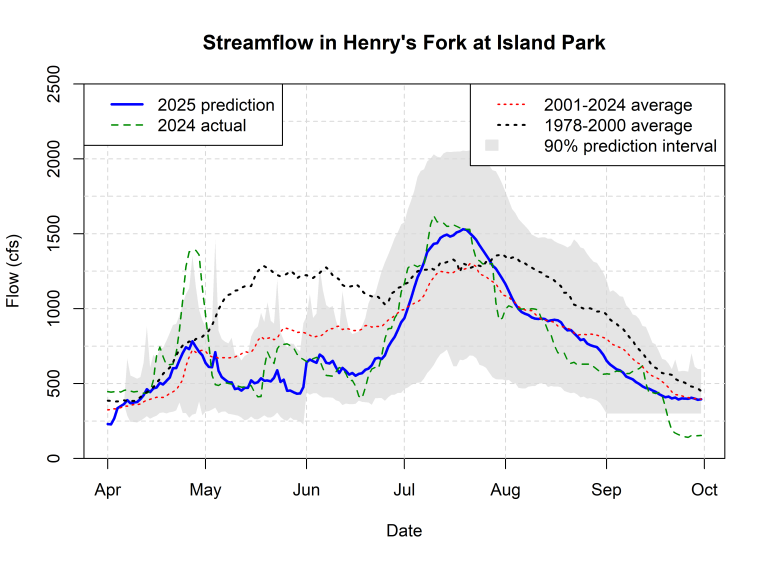
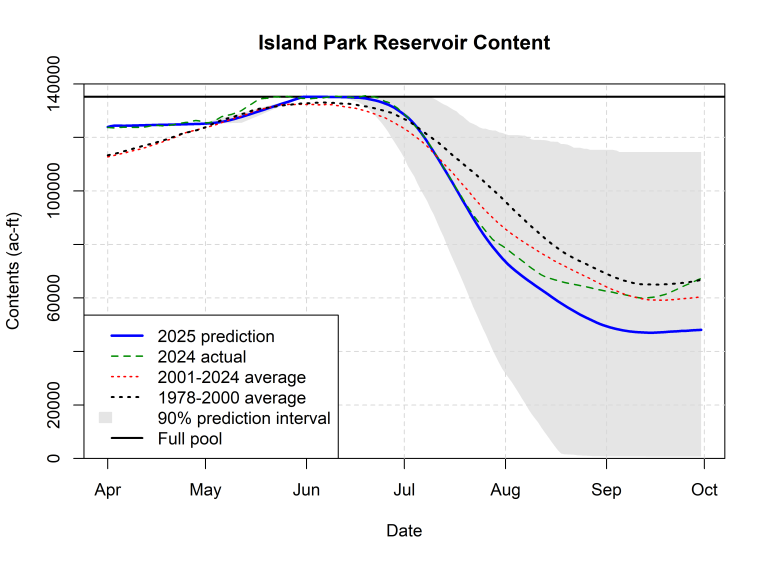
Irrigation management and regulated streamflow are expected to be very similar to last year. Island Park Reservoir will fill by May 31 at outflows most likely in the range of 400–750 cfs. The earliest that reservoir draft will be needed to meet irrigation demand and lower-watershed streamflow targets is May 31, with an expected date of June 24. By way of comparison, reservoir draft started in 2024 on June 20. Initial reservoir draft will coincide with need to deliver water from the Henry’s Fork to the Teton River through the Crosscut Canal, as Fall River is expected to contribute more streamflow than it did last year. Streamflow in the lower Henry’s Fork and Teton River will drop to irrigation-season low-flow targets in late June and stay there for the remainder of the summer if not even into the month of October. Peak outflow from Island Park Reservoir is expected to be around 1,500 cfs for much of July but could reach as high as 2,000 cfs during the middle of the month. The reservoir is expected to end the irrigation season at 36% full, compared with around 44% full last year and on average. However, the expected range of outcomes is large and dependent on summertime weather, and there is a 40% chance that the reservoir will end the summer at or above the long-term average.
Water Quality & Fishing Experience
Water quality in and downstream of Island Park Reservoir is expected to be about like it was last year, with relatively high turbidity and water temperatures. While a cool, rainy summer could keep water temperatures lower than expected, it is unlikely that turbidity and sediment load will be as low as they were in 2017, 2018, 2019 and 2023, the four wettest years we have experienced since we first installed our water-quality monitoring network in 2014. All three of these key water-quality parameters could end up being the highest we have recorded since then as a result of low reservoir inflow. This year’s Box Canyon trout population is expected to be about the same as last year’s, which is 33% lower than the average prior to construction of the Island Park hydroelectric plant in 1995 and 20% lower than the average since then. However, the population will contain good numbers of age-2 fish because of good winter outflow from the dam in 2024, hopefully benefiting summer fishing on the Henry’s Fork even more in years to come.