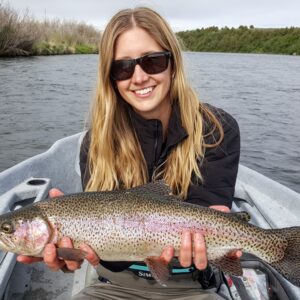
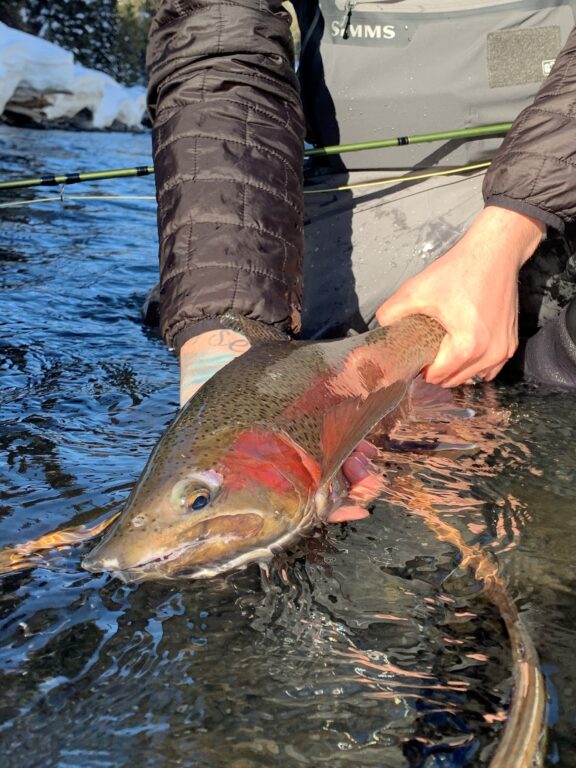
This is an issue that we know means a lot to a lot of folks. The health of the trout we fish for and seek to protect is something we as an angling community care deeply about.
Let’s talk Henry’s Fork specifically
As of late July, water quality continues to be good for this time of year, although water temperatures have been exceeding 70 degrees in the afternoons at the usual warm spots: Buffalo River, Pinehaven, St. Anthony and Parker.
For example, on July 23rd, water temperatures exceeded 73 degrees at Pinehaven (immediately downstream of the Ranch) from 5:15 p.m. until 8:45 p.m., which put them into the stressful range for rainbow trout. Temperatures exceeded 68 degrees at Pinehaven, the top of the optimal range for rainbow trout, from 1:30 p.m. until 1:00 a.m.
How does that affect each individual trout in the river?
The actual effect on an individual trout on the Henry’s Fork depends on a combination of dissolved oxygen and temperature, with high dissolved oxygen concentrations decreasing the stress at a given temperature.
Minimum dissolved oxygen concentration at Pinehaven occurs at around 6:00 a.m., while minimum temperature occurs at around 7:30 a.m. Maximum dissolved oxygen concentration on a sunny day occurs at around 3:30 p.m., well ahead of the maximum water temperature, which occurs this time of year at around 7:00 p.m.
The most stressful time for a fish choosing to stay in that location of the river is between 4:00 p.m. and midnight, when temperature is warm and dissolved oxygen concentration is increasing. The least stressful time is between 8:00 a.m. and 4:00 p.m., when dissolved oxygen is highest and temperatures have yet to reach their peak for the day. If you want to limit your potential impact on individual fish, you might avoiding fishing after 4:00 p.m.
The most stressful time for a fish choosing to stay in that location of the river is between 4:00 p.m. and midnight. The least stressful time is between 8:00 a.m. and 4:00 p.m.
How do individual fish respond to warmer temperatures?
The Henry’s Fork Foundation’s water temperature data show that the Pinehaven sonde, located river right on the Pinehaven dock, is located in the warmest part of the river reach between Island Park Dam and Riverside.
Even on the left side of the river, directly across from the Pinehaven sonde, water temperatures are about 5 degrees cooler, staying well below the stressful range throughout the day and in fact staying largely within the optimal range. Temperatures are even cooler just upstream of there, where springs enter the river.
If fish prefer the cooler temperatures available to them, they can easily move to those locations. If they choose to stay in the warmer locations, they are likely doing so to take advantage of the higher growth opportunities afforded by warmer water. The optimal range for rainbow trout growth and activity tops out at 68 F. The Henry’s Fork, however, is a unique environment. Because trout have high dissolved oxygen levels and the availability of large amounts of food, the closer that water temperatures are to 68 F, the faster that trout on the Henry’s Fork grow.
New research into thermal tolerance and preference by rainbow trout is showing that given the choice, most fish choose to remain in relatively warm river reaches because of increased growth potential and that when compared to fish in the same population that choose to spend the warmest part of the summer in cooler locations, the ones that stay in the warmer locations have greater fitness and body size due to higher growth rates.
This doesn’t mean that the stress of being caught doesn’t affect an individual fish that chooses to stay in warmer water, but the data show that the population as a whole benefits from most fish choosing the higher-temperature, higher-growth environments.
Why doesn’t Idaho Fish and Game institute “hoot-owl” closures?
Here is IDFG’s response.
What can anglers do?
Anglers can choose to limit their potential impact by not fishing when temperatures are high and dissolved oxygen is low—during the late afternoon and evenings in this case.
Did you know HFF has a Harriman Ranch Water Temperature Monitoring Program?
Learn more about how the program started here.
What are the latest findings? Check them out here.
View Ranch Water Temps