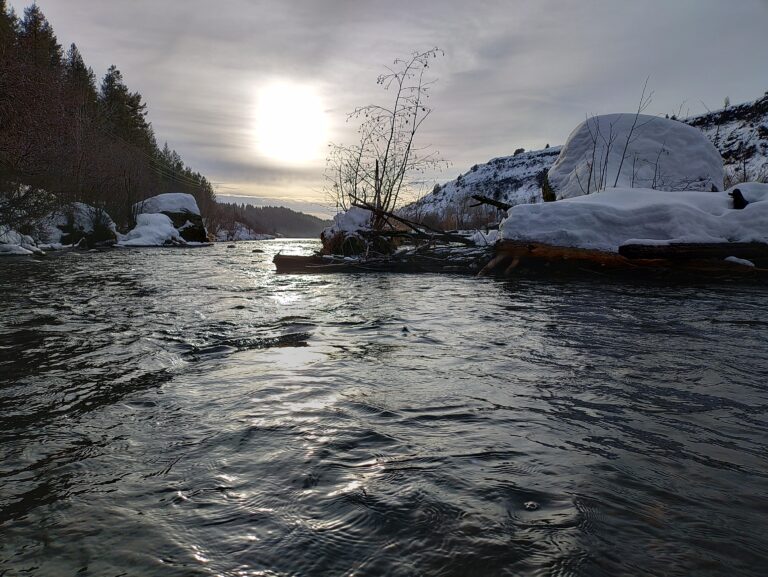
Looking downstream from Island Park Dam on January 6, 2025 after a fresh snowfall.
How did Island Park winter flow shape up in 2025? Winter flow in Island Park refers to the December–February (“winter”) period critical for survival of juvenile rainbow trout immediately downstream of Island Park Dam (primarily in Box Canyon), a period of time that ended last Friday. So, if you missed the daily water report in which I analyzed winter streamflow at Island Park Dam and downstream through Box Canyon, I share the results below.
Beyond just digging into winter flow operations in 2025, I also share answers to questions like:
Why is winter flow so important?
What about low flows in the fall?
What about the glory days?
What role does hydropower play?
Why is precision management good for winter flow?
What does the future hold?
This blog post is long—about a 15- to 20-minute read-time—I recognize that. But I have been working on this topic for 30 years and wanted a place to share everything we know in one place about the role of winter flow in producing trout for the Box Canyon and Ranch fisheries. I encourage you to read the blog post in full, even if you must start piece by piece. Please share it with your family, friends, and fishing buddies. And don’t hesitate to reach out to HFF’s Science and Technology team with additional questions.
Why is winter flow so important?
For those of you who may not know the significance, science, and history of winter outflow from Island Park Dam, here are the basics.
Currently, survival of juvenile trout through their first winter is the only factor limiting the number of rainbow trout in the Henry’s Fork fishery between Island Park Dam and Riverside. We know this thanks to a large amount scientific research published over the past 30 years by Idaho Department of Fish and Game (IDFG), Montana State University, Idaho State University, and Jim Gregory (and these links point to only a very small amount of published literature on this subject).
Let’s start at the beginning of a Box Canyon trout’s life: spawning. Combining the Buffalo River and mainstem Henry’s Fork, wild trout spawning produces around 100,000–250,000 young-of-year fish that are born in the spring and are present in the river each fall. Those fish are around 4–6 inches long and survive well until the water gets cold enough that they literally cannot move (typically by late November).
Because fish are ectotherms (“cold-blooded”), their body temperature and metabolism are determined by the temperature of their environment. In the case of these young-of-year fish, once water temperatures drop into the low 40s and below, their metabolism slows down to the point where they can move only very slowly, which makes them more vulnerable to predators. To avoid predation, they require what we call “concealment cover”—cover that will completely hide them from predators. Young-of-year fish prefer cover in between cobbles and boulders on the stream bottom and along the banks. Their second choice is similar spaces in and around woody debris along the streambanks.
In the Island Park-Riverside reach of the Henry’s Fork, that type of cover is largely found in Box Canyon, although a small amount is present elsewhere between there and Riverside. Further, more flow means more cover. So, a larger number of fish survive the winter when winter flow is higher. Based on the research cited above, the total amount of winter habitat is enough to support somewhere around 2,000–15,000 young-of-year over the winter, regardless of how many of these fish are present in the fall. So, even in a “poor” spawning year, where the total number of young-of-year may only be around 100,000 fish, there are far more young-of-year present than there is habitat. There are more young fish than the river can house. Adding more young-of-year (say in a really good spawning year of 250,000 fish) does not increase the amount of winter habitat. Increasing winter flow is the only way to create more habitat and hence more wild trout. About half of the young fish that survive their first winter survive their second year to join the fishable population of trout when they turn two years old.
Idaho Department of Fish and Game (IDFG) counts these two-year old fish, called “recruits”, in its springtime population surveys in Box Canyon. Since starting its modern survey methodology in 1995, the number of two-year old fish entering the population has ranged from a low of 1,078 in 2016 (following very low winter flow in the winter of 2014-2015) to a high of 8,474 in 2013 (following very high winter flow in the winter of 2011-2012). The average is 3,243.
Between HFF and IDFG and university partners, we have run the statistics every which way and the answer is clear: rainbow trout recruitment is highly correlated with streamflow through Box Canyon during the coldest 90 days of the fish’s first winter. On average, that coldest 90 days occurs from December 1 to February 28.
To get technical: The best predictor of recruitment is total streamflow through Box Canyon (Island Park outflow + Buffalo River flow). But only the outflow from Island Park Dam can be controlled. So the mathematics of creating larger rainbow trout population boils down to maximizing December-February outflow from Island Park Dam.
How do you maximize winter flow? There are two strategies: 1) minimize drawdown of the reservoir during irrigation season to begin with (minimize the “storage gap”) and 2) lower flows in the fall to fill the storage gap as much as possible to “save” water for winter flow.
So, what about low flows in the fall?
Each year, Mother Nature gives us a finite amount of water to fill the reservoir during the winter and spring. Therefore, any strategy to maximize winter flow must store more water in the fall. The only way to store water in the fall is to lower outflow—an unfortunate, but necessary tradeoff to get higher winter outflow and thus more wild trout.
People often ask me, “Could low fall outflows be counterproductive? Could these operations result in fall-season trout survival that is lower than what we’re earning from higher winter flows?” It’s a great question, and one that the above-mentioned researchers have all studied carefully over the years, and we continue to do so every year. To date, HFF and the collective group of researchers have yet to find any statistical evidence relating fall flows to the number of rainbow trout in the recruit class two years hence.
Mechanistically, there are two primary reasons for why fall flows don’t impact how many trout are in the population:
Together, the combination of aquatic vegetation and streamflow maintain the river depth needed for preferred trout habitat. During the fall, there is enough aquatic vegetation in the channel that the river depth at 200–300 cfs is the same or greater than the river depth at 400 cfs during the winter, when the plants are absent. (Think about how stepping in a bath displaces the water and increases the depth. Yep, plants can do the same thing in the river!). Sufficient plant growth generally remains in the river through November. So, it’s really depth that matters, not flow. And maintaining the same depth requires more flow in the winter than in the fall. Need a visual? See a depiction here.
The fish are also much more active and able to avoid predators during the fall, when water temperatures are relatively warm. On average, temperature in both the Island Park Dam outflow and the Buffalo River stays above 40 degrees until late November before dropping into the 30s.
Now, that is not to say that an early cold spell in November doesn’t occasionally result in “winter” from the fish’s perspective arriving a little earlier than December 1. In those years, optimal survival would require higher winter flow during part of November. An early “trout winter” doesn’t happen often enough to show up in the statistical analysis, so the calculations of winter flow undertaken at the beginning of the fall will maximize trout recruitment, on average, if we plan for maximizing outflow from December 1 to February 28. The opposite also happens; trout winter can start later than December 1. In both of these cases, the Drought Management Planning Committee can and does make small adjustments to timing and amount of winter flow as conditions unfold.
However, the science remains very robust that over the long term, maximizing December–February outflow—even if that requires low outflow during October and November—will produce the largest trout population.
What about the “glory” days?
The 1970s, 1980s and early 1990s are generally considered to be the best years of the Henry’s Fork fishery in the Island Park to Riverside reach. Fish numbers were high, and the fish were large in size. Why? Well, before 1994, the population was at least partially supplemented by 1) in-river stocking and 2) migration of fish (both wild and stocked) from Island Park Reservoir into the river downstream. Winter flow is essential for maintaining wild trout populations in the river between Island Park and Riverside. But with in-river stocking and reservoir-to-river migration, winter flow had a lower effect on the fish population before 1994, when a fish screen was built to prevent fish from going through the new powerplant and its hydroelectric turbines.
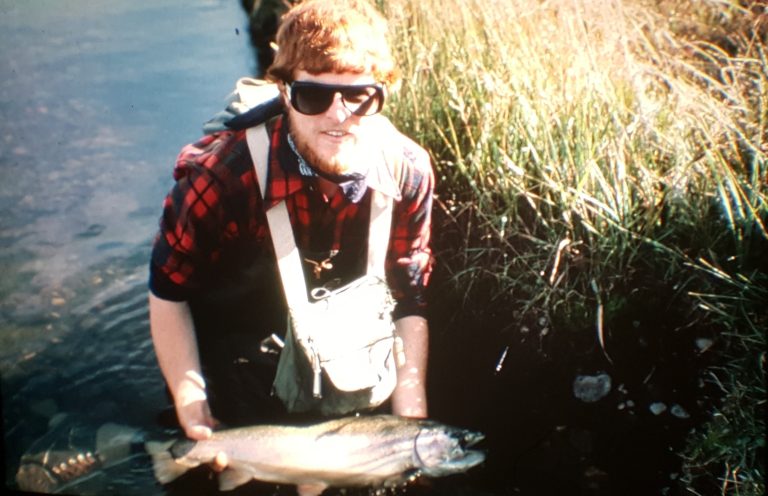
26-inch rainbow trout I caught on the Ranch in 1984.
Back in 2000, I worked with a colleague from IDFG to carefully document the history of the trout population using original data sources dating back to the 1800s. IDFG stopped routinely stocking rainbow trout into the Island Park-to-Riverside reach after 1977. Further, prior to the Island Park Dam power plant construction (on river left), all outflow passed through the un-screened dam gates (on river right). Reservoir fish congregated at the dam and routinely migrated through the dam gates downstream into the river—especially during the mid- and late-summer, when reservoir elevations were low, water quality in the reservoir was at its worst, and outflow was high (all things we try to avoid these days). Since the hydroelectric facility came online in 1994, most outflow passes through the screened power plant, preventing most downstream migration of reservoir fish into the Henry’s Fork. Some still make it into the river in years such as 2016, when the reservoir was drawn down to only 15% full, and the reservoir was too low for the power plant to operate for much of the late summer and fall.
Thus, winter flow was not a major issue for the fishery until the winter of 1994–1995, when the Henry’s Fork trout population could no longer rely on reservoir out-migrants.
What role did hydropower play?
Although winter flow was not a major issue for the fishery prior to 1994, it was important for hydroelectric power production—not at the Island Park power plant, which wasn’t built yet—but for plants at Ashton and Idaho Falls. The City of Idaho Falls generates its own hydroelectric power, and demand is high during the winter.
Before 1971, outflow at Island Park Dam was reduced on November 15 to almost zero to begin filling the reservoir for the winter. Why? To align physical and paper reservoir storage water to a greater degree than is done today. Such operations resulted in mean winter flow of 168 cfs from 1939–1970.
In 1971, water managers, water users, and hydroelectric interests downstream (then Utah Power and Light at Ashton and St. Anthony, and the City of Idaho Falls) negotiated a formal arrangement in which managers would start storing water in Island Park Reservoir as early as possible in the fall to provide higher winter flow for mid-winter power production downstream, when demand was high. Essentially, this agreement initiated the same overall management strategy as is implemented today and resulted in an average winter flow of 367 cfs from 1971–1994. Little changed once the Island Park hydroelectric power plant came online in 1995 except that now the fishery was much more dependent on winter flow via survival of wild trout. Mean outflow from 1995–2004 was 429 cfs—the highest of any well-defined management period—primarily because of exceptionally high winter flows during the extremely wet period of 1995–2000.
In 2005, the Henry’s Fork Drought Management Plan was finalized and signed by Fremont-Madison Irrigation District, North Fork Reservoir Company, U.S. Bureau of Reclamation, Henry’s Fork Foundation, Trout Unlimited, and The Nature Conservancy. With that plan in place, the Drought Management Planning Committee adopted a more aggressive fall fill strategy to maximize winter flow. Unfortunately, winter flow averaged only 316 cfs from 2005–2018 due to drought.
So what just happened during the 2025 winter?
From December 1, 2024 to February 28, 2025 (the winter period critical to juvenile trout survival in Box Canyon): Mean outflow from Island Park Reservoir was 288 cfs. How does this compare to management goals and the deeper past?
With a winter flow of 288 cfs, we achieved 13 cfs more than the original winter flow target of 275 cfs set by the Henry’s Fork Drought Management Planning Committee in early December.
However, winter flow this year was 19% lower than the 1978–2024 average of 354 cfs, ranking 28th out of the past 48 water years. Why? Low outflow was primarily the result of low natural flow in the watershed upstream of Island Park Dam, which itself was only 375 cfs, ranking 35th out of the last 48 water years.
But outflow from Island Park Reservoir is one thing—winter flow through Box Canyon is what the fish actually experience. This year, average winter flow through Box Canyon was 482 cfs, ranking 29th out of the 48 water years since 1978. The river’s natural flow through Box Canyon (what would have been in the river without storing water in Henry’s Lake and Island Park Reservoir) was 569 cfs, ranking 35th. Thus, actual flow through Box Canyon was only 15% lower than natural flow—amounting to 87 cfs that was stored in Henry’s Lake and Island Park Reservoir and leaving the remaining 85% of the river’s natural flow in the river.
It turns out that winter outflow from the Island Park Dam is highly dependent on water supply during the previous water year, since that not only determines how much water needs to be released from the reservoir during irrigation season to meet irrigation demand but also determines the natural base flow available during the fall and winter to fill the reservoir.
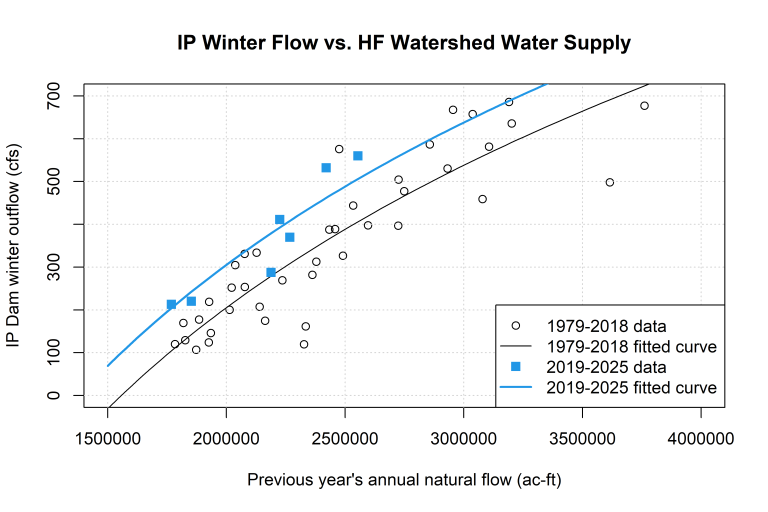
Based on the statistical relationship between water supply and winter outflow, we expected the 2025 winter outflow to be 280 cfs. With an average winter outflow of 288 cfs, we beat that expectation. In fact, this was the 7th consecutive winter that outflow from the reservoir beat expectations based on water supply. This coincides with HFF’s efforts to improve precision water management infrastructure, data provisioning, predictive models, and strategies to save water in the reservoir that were first implemented in 2018.
Why is precision water management good for winter flow?
In the last 7 years, winter outflow from Island Park Reservoir has averaged 371 cfs—which is 100 cfs greater than expected based on water supply and pre-2018 management (see graph below). That 100 cfs is equivalent to an additional 500 rainbow trout recruited into the population each year, a 15% increase compared to the long-term average.
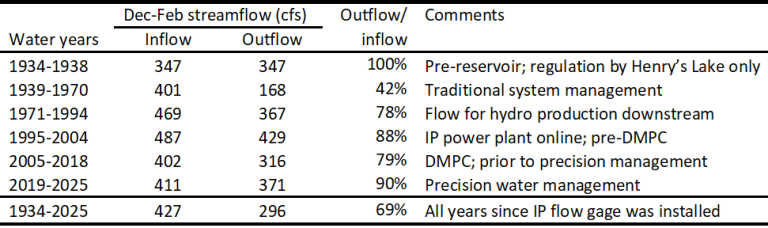
The average winter outflow of 371 cfs over the 7-year precision management period is greater than during any of the other management periods except 1995–2004, which included the longest sequence of very wet years on record in the Henry’s Fork headwaters.
Check out the table below. First, let’s look at winter inflow. Inflow is the natural flow that comes into the watershed between Henry’s Lake Dam and Island Park Dam plus a small amount released from Henry’s Lake Dam. If we look at winter inflow to the reservoir across these different time periods, we can see that inflow was much greater between 1970 and 2000 than it was before or has been since.
Now, let’s look at the outflow-to-inflow ratio. This ratio is the fraction of inflow that is released from the reservoir as outflow—essentially how much water goes out vs. how much comes in. Since 2018, the outflow-to-inflow ratio has been higher than any of the other management periods, even those with higher inflow. What does this mean? A higher winter outflow-to-inflow ratio means that 1) less water was stored in the winter and 2) more water was used for winter flow.
Specifically, the 90% outflow-to-inflow ratio over the past seven years means we were spending 90% of inflow on winter flow and only using 10% of inflow to fill the reservoir. How was this possible? By limiting reservoir drawdown as much as possible in the summer and storing as much water as possible during the fall. Without these management improvements, winter flow over the past seven years would have averaged 271 cfs, lower than during any period except 1939–1970.
What does the future hold?
From research we have recently published, we now know that streamflow in the upper Henry’s Fork has been declining for the past several decades and is likely to continue to do so in the future as growing-season temperatures and evapotranspiration continue to increase. Using trends in these variables, we have simulated water supply 30 years into the future and calculated expected winter flow at Island Park Dam, both with current management (around 90% of inflow being passed as outflow) and if we were somehow able to pass 100% of inflow as outflow (thus storing no water in the winter). We then used the well-established relationship between trout recruitment and winter flow to estimate the size of the Box Canyon trout population we can expect 30 years from now. The results, in comparison to the 1978–2000 and 2001–2023 averages, are shown in the graph below. The solid line in the middle of each box is the median population over the time interval, which is the population we would expect in the average year.
You can see that the median population since 2001 is about 25% lower than that from the late 1970s through 2000. That initial reduction is largely due to drought and fish screens at Island Park Dam. As drought conditions continue into the future, the wild Box Canyon trout population will likely be another 5–10% lower, even if we are able to pass 100% of the reservoir’s winter inflow as outflow (that’s the natural flow scenario shown by the box plot on the far right of the graph)—even if there was no dam at all.
Conclusions
Winter flow in the seven years since improved water management strategies were first implemented has been the highest relative to water supply of any management period since Island Park Dam was built in the 1930s. That’s a big win for wild trout. In fact, if you can believe it, winter flow over the past seven years has even been higher than it was during the best years of the Henry’s Fork fishery in the 1970s and 1980s. The difference is that stocking and down-migration of reservoir fish added to the wild trout population back then. The wild component of the population right now is about the same as it was back then, but the additional 25% was made up from other sources of recruitment.
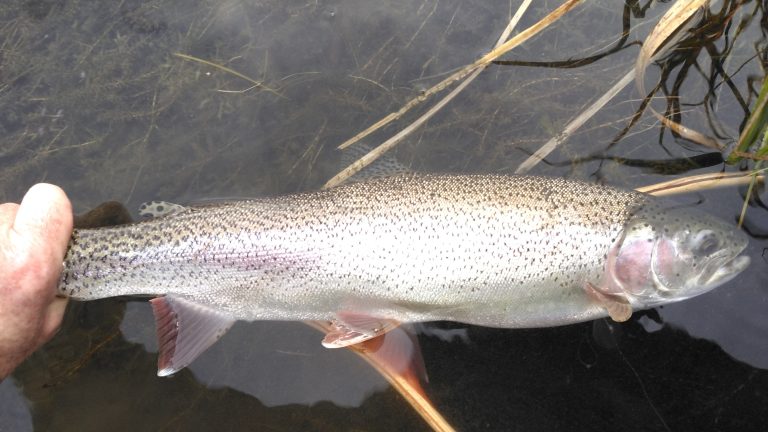
Healthy, wild 18-inch rainbow trout I caught on the Ranch in 2023.
As we continue to see declining water supply, we will have to work even harder (mostly through even lower flows in the fall) to maintain our current 90% outflow rate. Even if we are somehow perfect in managing the reservoir and pass 100% of inflow all winter, the trout population will still be around 30% lower than it was 40 years ago. It’s hard news to hear. But, unfortunately, we can’t do any better than this simply because Mother Nature is giving us less streamflow and we can’t make any more water. With this albeit sad, but scientifically sound conclusion, sometimes folks ask if the Henry’s Fork fishery is dead. The answer is no—just different. But for those of us who fish the Henry’s Fork between Island Park and Riverside, we will either need to accept a lower trout population or find creative ways to offset the additional ~30% of the population that was provided by sources beyond wild reproduction prior to 1994. I believe in our ability to adapt accordingly.
As it is the afternoon of December 31, I am closing the year with my annual fish-of-the-month blog, this one at the end of my 11th year of catching a fish in my home waters in each month of the year. To spare you the math, that’s 132 consecutive months of catching a wild trout or whitefish (and in some years I’ve fair-caught suckers and shiners, too) within a three-hour drive of my home in
In this blog post, we 1) present our turbidity and suspended sediment data, 2) explain our suspended load calculations, and 3) provide some additional information justifying why we think that a substantial amount of bed load was transported into the Henry’s Fork in addition to the suspended load. Since first observing high turbidity in Thurmon Creek and the Henry’s Fork downstream associated with the Silver Lake drawdown in November 2025, HFF’s Science and Technology team
Written by Doris Squeri Tom and I met on our first day of grad school back in 1982. We were both broke and stressed, and we both loved the outdoors, so I decided that an affordable way to relieve some of that stress might be to learn how to fly-fish. We had learned to fish with our dads when we were very small, but it was bait fishing, and we wanted to try something new.
The Henry’s Fork Drought Management Planning Committee (DMPC) met on Monday, November 24 to set this winter’s outflow and reservoir-fill strategy for Island Park Reservoir—an annual decision with implications for winter trout habitat in Box Canyon and the Ranch. Winter Outflow: What’s Coming on December 1 Beginning December 1, outflow from Island Park Dam will increase, bringing winter streamflow through Box Canyon to ~380 cfs from December through February*. That equates to 76% of Box