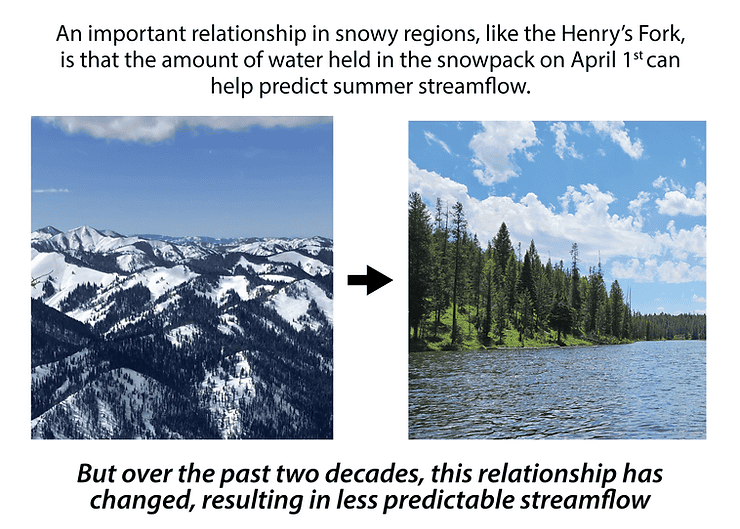
In snowy regions like the Henry’s Fork, the amount of water held in the snowpack on April 1st can help predict summer streamflow. But over the past two decades, the relationship between the water stored in spring snowpack and summer streamflow has changed, making summer streamflow less predictable. New research by HFF and Idaho State University scientists show how we can improve our summer streamflow predictions by better understanding when snowmelt and rain enter the ground relative to the forest growing season.
Key Takeaways:
The amount of snow that becomes streamflow depends on both past and current conditions.
Predicting streamflow requires accounting for changing forest dynamics.
Less snowmelt becomes streamflow after years when more water enters the soil during the forest growing season.
Why is it important to be able to accurately predict water supply?
Part 1 discussed how warmer temperatures and changing forest dynamics are contributing to water supply decline in the Henry’s Fork. At the Henry’s Fork Foundation, if we want to reduce drawdown of Island Park Reservoir and increase winter flows to grow more trout, we need to be able to accurately predict water supply. Understanding watershed processes are key for those predictions—but these processes are changing and impacting the quality of HFF’s predictions.
How do watershed processes impact water supply predictions?
Created by Sarah Newcomb
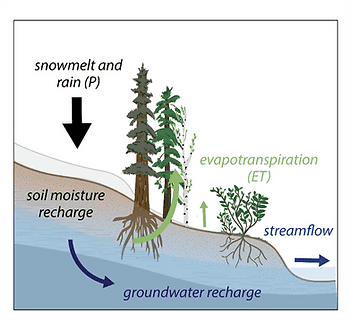
Since the severe drought of the early 2000s, less water from spring snowpack is turning into streamflow, leading traditional approaches to over-predict summer streamflow. This poses the risk of us going into the summer thinking we have more water than we actually do. Predicting this change presents a new challenge, since most approaches do not account for changes in forest cover or evapotranspiration (ET; how much water evaporates or is used by plants).
Precipitation becomes streamflow more effectively when incoming snowmelt and rainwater exceeds demand (potential evapotranspiration or PET). Potential evapotranspiration, or PET, simply has to do with how much water would evaporate if there was no limit to how much water was available. In the Henry’s Fork, high snowmelt and springtime rain lead to peak water inputs in the late spring. Demand (PET) has historically been lower during the early spring months. As a result, streamflow is higher during spring months when supply is high, and demand is low. We call this the ‘recharge period,’ because snowmelt and rain are recharging or adding more water to the system than is being taken out by ET. Changes to the recharge period will affect how much water becomes streamflow.
Changes in the recharge period can be due to:
Snow melting later
Snow melting slower (which results in fewer days where inputs are greater than outputs).
Warmer springtime temperatures (leading to earlier increases in PET) during the start of the growing season
What has HFF’s research shown?
To better understand the impact of a changing recharge period, HFF research presented a new unit of measurement, which we call the Vegetation-Water Alignment Index (VWA). The VWA calculates how water supply aligns with the growing season. The VWA helps us identify:
The recharge period
Changes in when and how quickly snow melts
Changes in forest vegetation
The length of the recharge period
Created by Sarah Newcomb
We found that streamflow is lower after years when more water entered the ground during the forest growing season (smaller recharge period) instead of before the growing season. Since the VWA provides us with information about future streamflow, it can be used to help us improve our streamflow predictions from year-to-year.
One reason predicting streamflow is challenging is due to the limited information known on April 1st, when most summer predictions are made. When applied to the major tributaries of the Henry’s Fork, the Vegetation-Water Alignment metric improved summer streamflow predictions in each subwatershed. Specifically, we found that water input and growing season alignment is particularly important in the low-elevation forests surrounding Island Park.
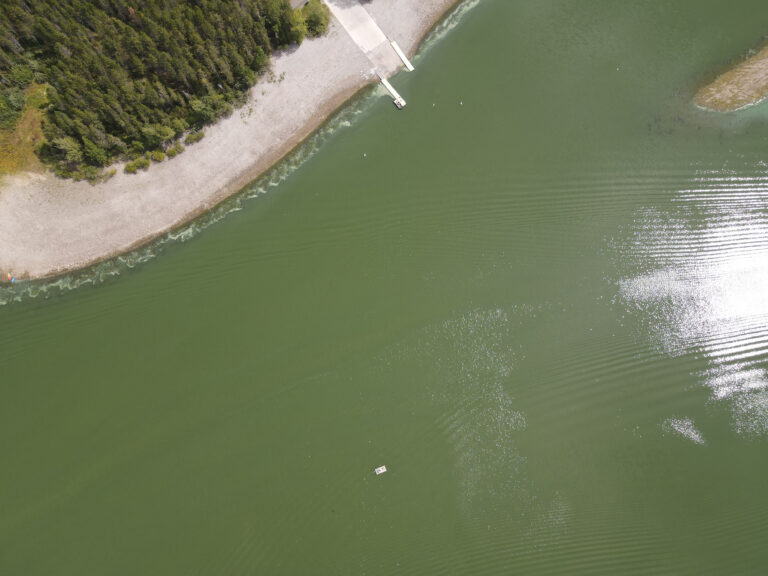
This story was written by Audrey Hunter (2026 intern) and was originally published in the Fall 2026 Newsletter. It’s no secret that late summers on Island Park Reservoir haven’t been in perfect conditions in recent years. Warm, turbid, algae-filled water plague reservoir recreationists while diminishing water quality downstream. Cyclical algal blooms decrease water clarity and create less-than-ideal circumstances for the reservoir’s flora and fauna. What’s the solution? HFF’s DIRTT Plan. In-Reservoir Oxygenation Nutrients released from
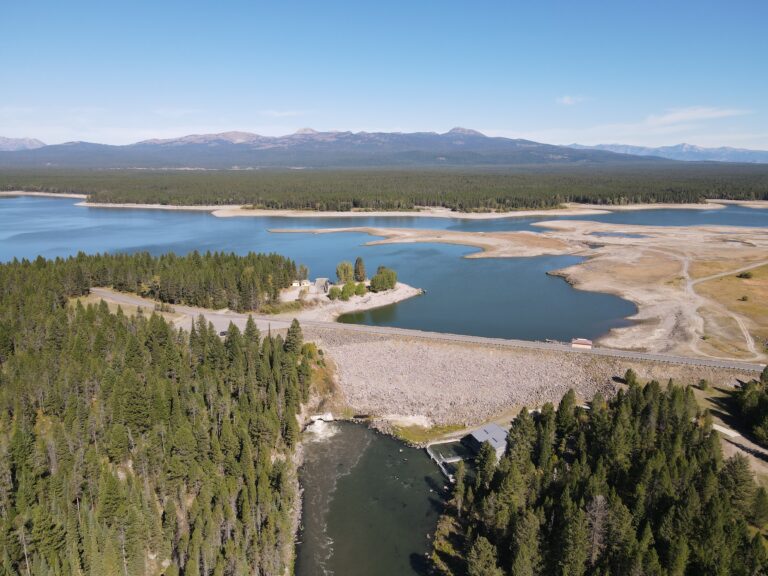
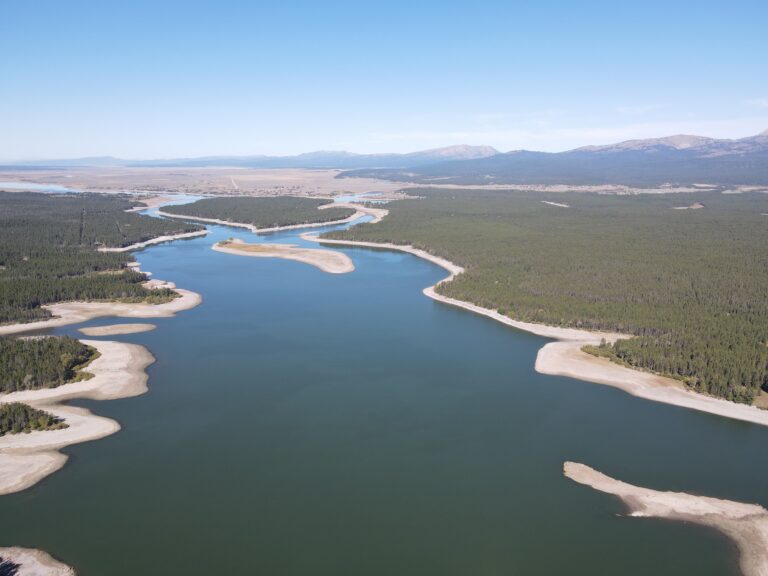
Drone photo taken on September 9, 2026 The Henry’s Fork Drought Management Planning Committee met on Wednesday, September 16 2026 to develop an updated reservoir management strategy. Downstream of the Henry’s Fork watershed, lower-valley irrigation demand over the rest of the season is anticipated to be slightly lower than projected last week, so Island Park Reservoir and Grassy Lake (in the Fall River drainage) do not need to deliver any more water out of the
This year has brought the Henry’s Fork watershed an extraordinary water-supply challenge. Natural flow is exceptionally low, and Island Park Reservoir is ending the summer at a near-record low level. But there is another important part of this story: we knew these conditions were coming, we planned for them, and water managers are managing the water we have as carefully as possible. HFF is one of the 6 official signatories to the Henry’s Fork Drought
Why is Island Park Reservoir getting so low? Simply put, this has been an exceptionally low-water year. There isn’t enough natural flow to meet all of the basin’s needs without drawing down reservoirs. Water managers are working together to deliver water that is legally owed downstream while preserving as much as possible for next year. What should anglers expect below Island Park Dam? As Island Park Reservoir drops too low for the hydropower plant to