Fish ladder at the Buffalo River hydroelectric facility
Streamflows are rising, bugs are hatching, and rainbow trout from Riverside to Island Park Dam are on the move.
With less than one month remaining in this year’s spawning migration up the Buffalo River, it’s a good time to take stock of what the data show—and how they fit into nearly two decades of fish ladder monitoring. (See previous blogs1,2 for more background on the Buffalo River fish ladder.)
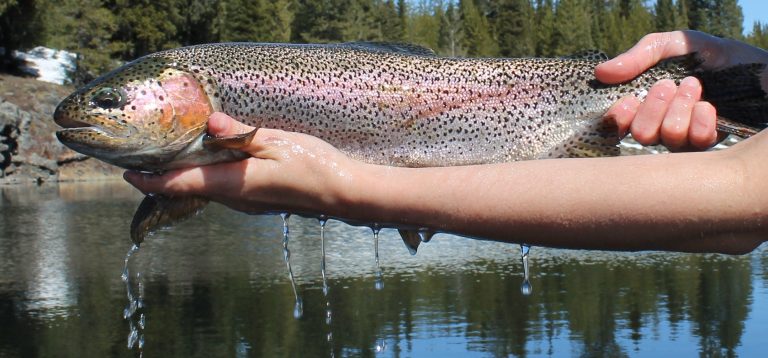 Spawning Female
Trapping for the 2025 season began on February 25th, capturing the full span of the spring migration to date. As of May 20th, we have recorded a total of 799 fish passing through the Buffalo River fish ladder, the vast majority of which were Rainbow Trout (72%) (Figure 1). Brook Trout comprised nearly a quarter of the total (23%), while other species (Mountain Whitefish, Mountain Sucker, and Speckled Dace) made up the remainder (5%). This species mix is consistent with previous years and underscores the dominant role of Rainbow Trout in the spring migration, particularly in the context of upstream spawning activity.
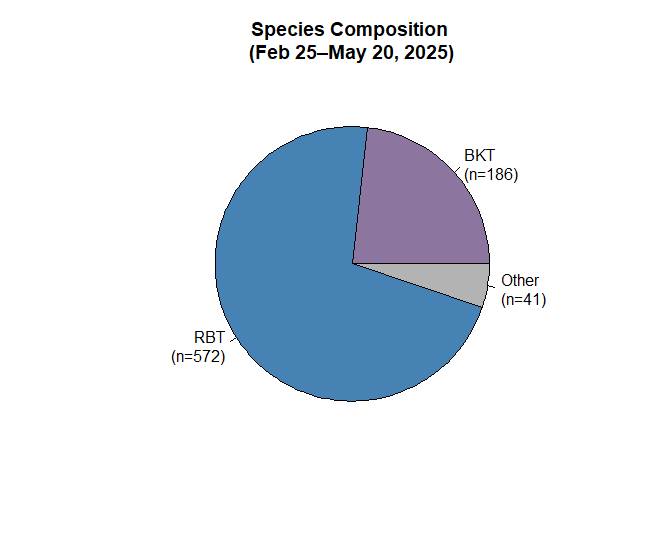 Figure 1 – Species composition of all fish observed at the Buffalo River fish ladder Feb 25–May 20, 2025.
The size distribution of ladder migrants reflects a broad range of age classes (Figure 2). Although a large number of smaller individuals (<300 mm) have been recorded—likely subadult trout or non-spawning fish—adult-sized fish (≥300 mm) are also well represented, particularly in the 350–450 mm range. This typical bimodal pattern reflects both migratory activity of subadult fish and the focused upstream movement of mature spawners. Notably, one Rainbow Trout observed this spring measured 585 mm, tying for the 8th largest individual ever recorded at the ladder. The largest Rainbow Trout on record measured 614 mm and was observed in 2014. (For reference, 25.4 mm equals one inch—a conversion I find easy to remember by thinking of four quarters in a dollar. Put another way, every 100 mm is roughly 4 inches. So, 585 ≈ 600, and 6 × 4 = a pretty good day on the river, by most standards.)
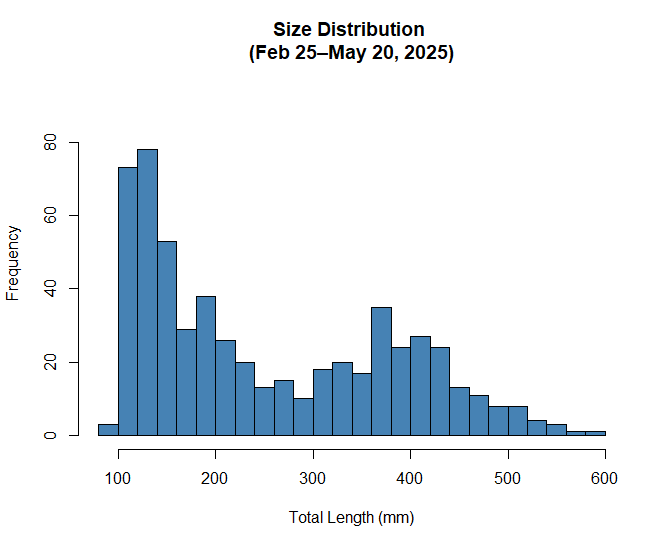
Figure 2 – The number of Rainbow Trout observed within each size range at the Buffalo River fish ladder Feb 25–May 20, 2025.
Focusing on adult Rainbow Trout, the 2025 spawning run began early, with a strong initial pulse of migrants in early March—ahead of both the 2024 run and the 2006–2024 average (Figure 3). After a brief slowdown in late March through early April, migration accelerated again in mid-April and continued at a steep rate through about May 9th before leveling off more recently. The current plateau suggests that the bulk of the run may already have passed, with 2025 shaping up to be an early but relatively strong migration year. This timing aligns with trends of rapid spring warming and early snowmelt.
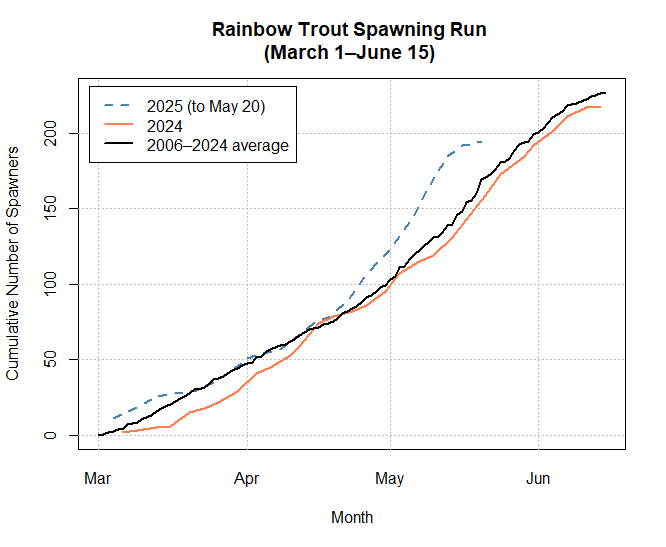
Figure 3 – Cumulative migration of spawning adult Rainbow Trout (≥300 mm) through the Buffalo River fish ladder, shown over the standard seasonal window of March 1–June 15 for consistent year-to-year comparisons.
With 195 spawners counted through May 20th and a projected season total of 257 spawners, the 2025 run is on track to finish slightly above the long-term average (Figure 4). This would place it above the historical median—more abundant than over half of all years—and comparable to runs observed in 2020 and 2022. Though far below the record-setting total in 2021, the 2025 projection suggests continued stability in spawning returns, possibly supported by above-average winter flow in 2024 (Dec 1, 2023–Feb 28, 2024).
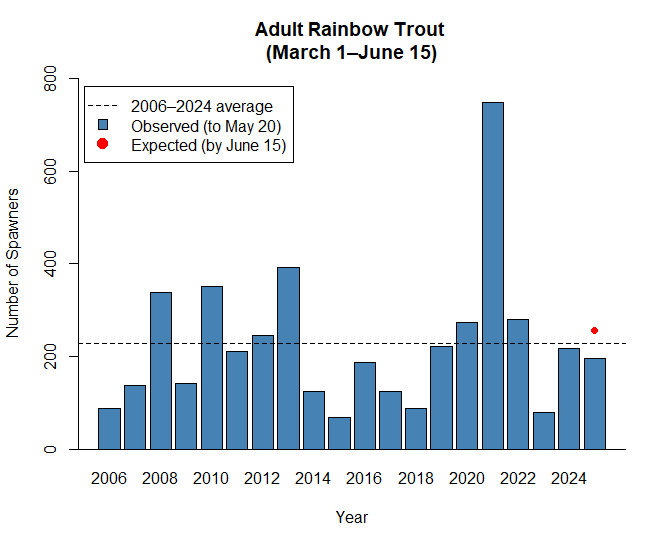
Figure 4 – Total number of spawning adult Rainbow Trout (≥300 mm) observed at the Buffalo River fish ladder by year, shown over the standard seasonal window of March 1–June 15 for consistent year-to-year comparisons. The red dot indicates the expected total for 2025, estimated using the historical proportion of the run completed by May 20.
Which begs the question: What made 2021 so exceptional?
One plausible explanation lies in the conditions that preceded it: average winter flows in 2018, 2019, and 2020 all ranked 12th or better out of the past 48 years—providing three consecutive years of above-average overwinter habitat for juvenile trout and setting the stage for a strong adult return. Those cohorts would have entered the population in 2019, 2020, and 2021 as age-2, -3, and -4 fish, respectively—just in time to dominate the 2021 run. The result was an extraordinarily high count that stands apart from the rest of the time series.
We’ll continue to trap and pass fish through late June. Be on the lookout for a full-season recap later this year—with final numbers, updated trends, and a deeper look at what the past three years’ data on Buffalo River migrants might tell us about the mainstem Henry’s Fork population and what lies ahead.