If the Henry’s Fork Foundation (HFF) is doing work on the South Fork, doesn’t that take away from the Henry’s Fork?
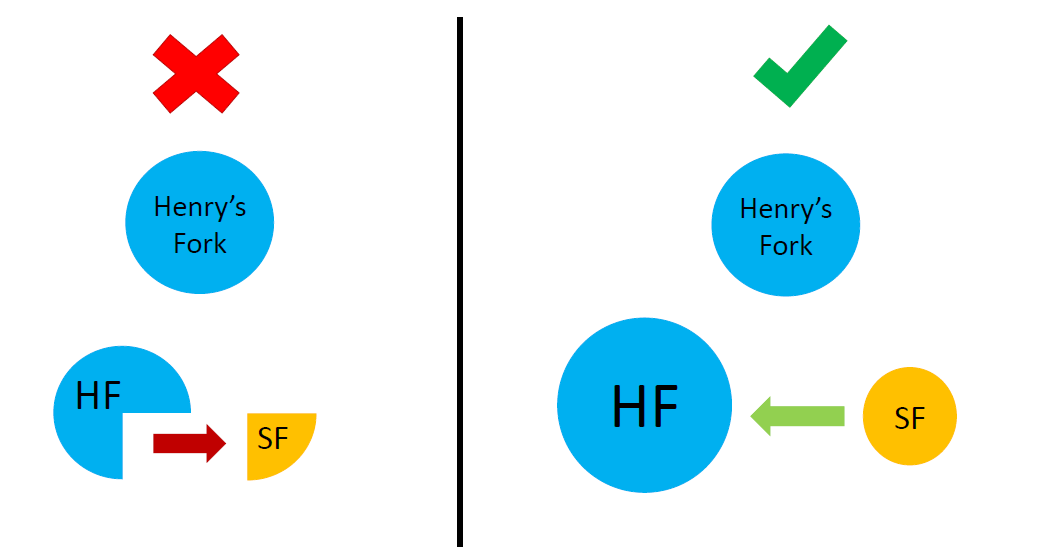
This is absolutely a logical assumption and concern than many have shared with us. If you think about HFF’s available time and resources as a pie, starting work on the South Fork must take a piece out of that pie, right? In this case, the South Fork Initiative (SFI) program was launched and is funded entirely by South Fork-only donors and grant sources, ensuring that all Henry’s Fork funds and effort stayed (and even grew) on the Henry’s Fork.
Here’s the short version:
- NO funding or resources were taken away from the Henry’s Fork for the South Fork Initiative (separate South Fork-only donors).
- Since the start of the SFI in 2018, more resources ($) and capacity have been directed towards the Henry’s Fork than EVER before (12 new and 35 total HF projects happening now).
- The SFI has brought in new funds and relationships for the Henry’s Fork.
- Water management decisions are made on a regional scale, and Palisades Reservoir is the center of the Upper Snake storage system.
- Having a stake in the South Fork opens up the opportunity to be a part of larger-scale water discussions.
- Keeping the South Fork healthy helps to avoid added fishing pressure on the Henry’s Fork.
How does that work?
When South Fork outfitters and citizens asked the Henry’s Fork Foundation to help on the South Fork in 2018, they raised all of the funds to do the work. No funding or resources are taken away from the Henry’s Fork. Instead, South Fork-specific donors and grants funded the work. In fact, that program has opened up new grant and funding sources that were previously unavailable to the Henry’s Fork, and are now benefiting the fishery there. Since the start of the South Fork Initiative in 2018, more resources, funds, and capacity have been dedicated to the Henry’s Fork than ever before. There are 12 new Henry’s Fork projects (since 2018) and over 35 total projects happening on the Henry’s Fork, currently. Simply in terms of funds and amount of work, the South Fork Initiative has been a net positive for the Henry’s Fork.
In terms of impact for the Henry’s Fork, the South Fork Initiative has also brought new relationships and increased influence in the water management world for the Henry’s Fork. Water management decisions are made on a regional scale, and Palisades Reservoir is the center of our water storage system. In fact, the Henry’s Fork and Island Park Reservoir appear quite small in comparison. But, being a part of larger-scale water discussions and having even some level of involvement on the South Fork, give us greater reach and influence to advocate for the Henry’s Fork.
Essentially, rather than the South Fork taking away a piece of the Henry’s Fork pie, it has simply made the Henry’s Fork pie bigger. HFF puts a great deal of time and careful consideration into any and every project or program, and a program’s benefit to the Henry’s Fork is prioritized above all else.
So what are you doing about the tough conditions on the Ranch last year?
As anglers know, 2022 produced very tough conditions on the Ranch, from turbidity (from sediment) to trout and insect populations. Many of HFF’s most crucial programs ongoing right now focus on the crux of the Ranch and upper Henry’s Fork fishery via Island Park Reservoir and its effects downstream. Some of these include, Precision Water Management Program (keeping water in Island Park Reservoir which increases trout populations and improves water quality), Farms & Fish Program (water conservation), spring freshets (clear sediment from the Ranch), and a new Harriman Ranch water temperature monitoring project.
We know the effects of drought have had a negative impact on the fishing experience in the Ranch. We have programs in place that not only help us better understand these natural systems, but improve conditions locally. Our work has increased the number of trout below Island Park Dam by 20% over and above what it would have been otherwise, and insect habitat has improved dramatically since the 1992 sediment event. We are also working on a plan to look at more potential actions to reduce the amount of sediment that comes out of Island Park Reservoir from the west end. More information on each of these can be found in the links throughout this text, but if you have specific questions, please contact us.